Monday, May 9, 2011
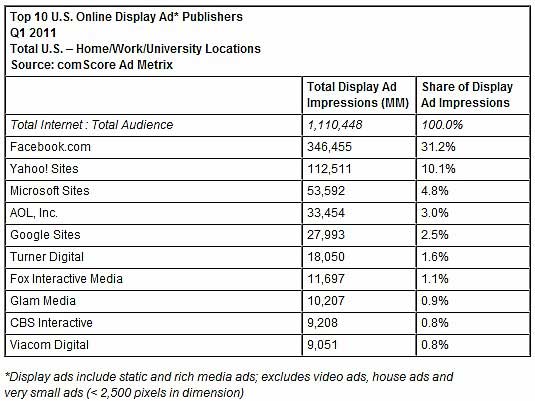
Facebook Kills it in Display Advertising
Tuesday, September 14, 2010
The Social Conundrum
Nick Kinports (follow him on Twitter @ADMAVEN) has worked in the interactive technology world for over 15 years, and helps the Fortune 100 identify unmet consumer needs, create ideas to fill those needs, and bring them into market. He currently works at Maddock Douglas.
Thursday, August 19, 2010
5 Ways Facebook Places Will Change the Marketing Game
Facebook's new Places feature is live, and it's bringing a whole new dimension to the world's most talked about social network.Advertisers, for now, are out of luck. In a live reveal of the technology Mark Zuckerberg, co-founder of Facebook, explained that the technology needs to be perfected (finding friends, checking-in and building stories about places via @benparr) before bringing FourSquare-like deals to the table.
When it happens - and happen it will - what can brands and agencies expect from the new technology? Here's my predictions and trends for location and deal based app marketing:
1) Deep group discounting
Facebook Places let's you check in your friends (unless they disable the feature in privacy settings). Expect brands and venues to begin offering deep discounts for large groups of friends checked in at the same time. Want 20% off your entire meal? Get at least 8 of your friends checked in on Places and reap the rewards!
2) Swarm behavior
Allowing you to see where your friends are every second of the day is a big benefit to Facebook's shiny new toy. I suspect that within 5 years being location aware of your network will be as ubiquitous as having a mobile phone. Until then expect advertisers to take advantage of swarming behavior by offering up to the second and unpublicized deals through Places. Business is down for the day? Seed a 50% off promotion through Facebook Places for the next 60 minutes and watch as the information achieves viral status and causes a swarm to appear in your venue.
3) Competitive cherry-picking
Businesses will need to be on their Places game to avoid losing valuable customers. The businesses that fail to adopt or understand how Facebook places work will become low hanging fruit for tech savvy competitors offering killer deals and discounts.
4) Privacy backlash
When businesses begin harvesting Facebook information about their visitors based on Places it's going to raise some major privacy concerns. The best way to avoid being the scapegoat for yet another Facebook privacy outrage is to play by the common sense rules of marketing in the age of social technology. Only contact people who have selected to receive your communications and bring tangible value to the table with each message. I suspect nightlife and entertainment venues will be among the first to ignite the collective wailing.
5) Social CRM
Social technologies bring a bold new dimension to CRM programs. Ensure yours will be compatible with Facebook Places and that you have built in processes to grab and analyze trends from the geolocation view.
For an overview of Facebook Places including how to use the new features click here.
Nick Kinports (follow him on Twitter @ADMAVEN) has worked in the interactive technology world for over 15 years, and helps the Fortune 100 identify unmet consumer needs, create ideas to fill those needs, and bring them into market. He currently works at Maddock Douglas.
Tuesday, August 10, 2010
Game Mechanics Increase Brand Engagement
Or do they?I was recently pitched on Jellyvision - it's an interactive (and pretty engaging) product that helps communicate complex topics. It reminded me of a concept that I've been meaning to address for a while now: game mechanics as a driver for brand engagement. We've all seen the obvious examples in FourSquare, Twitter (number of followers is similar to a score), and now websites that provide badges or achievements for clicking links, commenting and sharing content with your social networks.
Game mechanics make ads and websites more engaging
It may be a Millennial thing, but incorporating achievements or awards - even if they are valueless - in
front of consumers compels them to interact with content more often. Incorporating game mechanics into digital outlets doesn't make sense for everyone, but in the right environment against the right audience it can be the tip of the spear that drives return visits.
Not convinced? Here's another example of the game mechanic in action: Empire Avenue. As if you needed one more social media site to participate in... I like Empire Avenue because it takes the next step of creating a marketplace for social currency where you can buy and sell your friends for virtual currency just like stock markets across the world. On top of that you get the whole badge/achievement thing. Remember my old article on "The Currency of Like"? Here it is in action folks. Oh, and if you want to pick up some shares of me, I'm listed under the ticker symbol NICKK.What do you think? Are sites that build in game mechanics more successful?
Nick Kinports (follow him on Twitter @ADMAVEN) has worked in the interactive technology world for over 9 years, and helps the Fortune 100 identify unmet consumer needs, create ideas to fill those needs, and bring them into market. He currently works at Maddock Douglas.
Friday, July 9, 2010
Is Google Me the Social Media Measurement End Game?
Speculation on a competitor for Facebook is everywhere. If the purported 'Google Me' is real (and it sounds like it is) it means a big shift in the way advertisers think about social networks. Gone will be the proprietary and often misleading methodologies behind calculating social media ROI and true value. I have no doubt Google's plan includes deep integration with it's proprietary Google Analytics and Insights platforms - tracking clicks from entry to conversion.If Google finally hits the social technology mark (a goal that has, thus far, eluded the largest search engine in the world) it will mean a golden era in social measurement and reporting.
Do you think Google Me will present real competition for Facebook?
Nick Kinports (follow him on Twitter @ADMAVEN) has worked in the interactive technology world for over 9 years, and helps the Fortune 100 identify unmet consumer needs, create ideas to fill those needs, and bring them into market. He currently works at Maddock Douglas.
Wednesday, June 23, 2010
Do We Need a Social Media Bill of Rights?
I received an outreach email from the authors of Wild West 2.0 detailing their proposed social media bill of rights. Here's the summary followed by my analysis:The Social Media Bill of Rights
By Michael Fertik & David Thompson, Authors of Wild West 2.0: How to Protect and Restore Your Online Reputation on the Untamed Social Frontier
As social networks have grown in importance, ReputationDefender has seen a shocking pattern of privacy violations, ranging from inappropriate data sharing to attempts to trick users into revealing their personal information.
It is time users took back control of their online privacy. ReputationDefender presents this draft Social Media Bill of Rights to provoke thought about how social networking sites -- like Facebook, MySpace, Twitter, and others -- should treat users and protect privacy. We strongly believe that social networking sites should recognize and grant each of these rights to users in an open and transparent way.
Social Media Users Have These Rights
1) The right to privacy.
When in doubt, privacy comes first.
By default, users should not expose information to the world, to data brokers, to corporations, or to anyone else.
Users have the right to share as much or as little as they want. They are in charge of their privacy, and all data sharing comes only after user consent.
2) The right to choose.
Privacy settings must be easy and understandable. If your parents can't use it, then it's not simple enough.
Privacy controls should be easy to find. Social networks should put privacy controls next to where they are needed; near photos, near data collection portals, and other places where users expect to find them.
If taking an action (installing an app, using a new feature, etc) will expose or share data, users deserve to know before they commit. Social networks should explain the privacy cost of each new feature, and let them make an informed choice.
Interfaces should not be evil. Each interface should clearly communicate the privacy consequences of each action. Interfaces that collect or use data in a non-intuitive way should be clearly labeled and explained.
Any kind of external data sharing should be opt-in, not opt-out. If it's so useful, it will be easy to convince users to sign up. Outside corporations don't have a right to user information without clear user consent.
3) The right to data minimization.
Just because a social network can, collect information doesn't mean it should. Social networks should strive to collect no more information about users than what is required to present social functions.
Storing "click stream," "search history," and other data that is not directly tied to social functions is often an invitation to privacy invasions. Storing this data does not directly enhance user experiences and often violates user expectations.
When in doubt, aggregate. Aggregated data often fulfills the same function without the privacy risks.
We don't know the long-term consequences of mass-scale data collection and storage; it is better to err on the side of caution and data minimization.
4) The right to honest communication.
Users have a right to know how their information is being used. Tell them. Use language you'd use with friends, not language used by lawyers. Agreements should be easy to understand and not contain hidden legalese.
If something goes wrong, tell users openly and honestly so that they may protect themselves.
If aggregated data turns out to not be anonymous (like the Netflix Prize data set), tell affected users. Openness today will save headaches tomorrow.
Even if the lawyers can find a legal loophole, users deserve to be treated with respect; social networks should treat users as they expect to be treated, not at the minimum possible legal threshold.
5) The right to delete.
Users have a right to leave social networks. When they do, they should be able to easily take back their data too.
The right to delete includes deleting any marketing information or dossier that has been compiled about them, including any behavioral advertising data.
Exceptions are permitted for financial transactions and other records that must be kept for legal compliance.
6) The right to know.
Users have the right to know:
* how information about them is being collected;
* to whom their data is being sold;
* how their data is secured;
* how many people can see their personal information;
* when there are data security incidents, even if they don't trigger existing notification laws.
Disclosures should be in plain language.
If data is being collected in non-obvious ways (click patterns, through offline sources, etc) then it requires special notice.
7) The right to dignity.
Some information is too personal for social networks to demand or share. Even if it is possible to find out intimate secrets of users' lives, it is usually best to not.
There are limits on the wisdom of behavioral and contextual advertising, even if users have agreed to it. Social networks should think twice before trying to profit from their users' grief, weaknesses, or personal failings.
Social networking engineers should always ask themselves, "would I want my data to be used this way?" If not, don't code it and don't implement it.
Sites should not encourage users to debase, defame, or abuse each other. There is always another person at the other computer; remind users to treat each other with dignity.
8 ) The right to accountability.
Social networking sites should be willing to undergo regular privacy audits to prove they are using data only in approved ways. Sites that don't allow privacy audits should be considered suspect.
Leaders of social sites should accept personal responsibility for the security and privacy practices of their sites. If they make a false promise, they should be held personally accountable.
9) The right to not participate.
Users have the right to not participate in social networking. If they choose not to, social sites should not compile a dossier or file about them, even if friends volunteer that data.
Non-users should be able to find out how personal information about them is being shared or discussed (including "tagged" photos or facially-recognizable photos) without providing further personal information.
10) The right to social privacy.
Social networks should make it easy for users to help friends be respectful of privacy.
Social networks should not encourage users to violate each others' privacy. Interfaces that encourage prying or over-sharing are disfavored.
Social networks should allow users to contact each other about potential privacy violations and privacy requests. A simple "I'd prefer this photo not be online" notification system can help friends communicate their preferences without threatening free expression or creativity.
I generally agree that social networks have shady privacy practices. We've all seen the recent Facebook privacy gaffs (probably the tip of the iceberg). But do consumers really care? Are Millennials, for example, overly concerned how the data they voluntarily upload using social technologies is used by advertisers? Tell me what you think.
Nick Kinports (follow him on Twitter @ADMAVEN) has worked in the interactive technology world for over 9 years, and helps the Fortune 100 identify unmet consumer needs, create ideas to fill those needs, and bring them into market. He currently works at Maddock Douglas.
Tuesday, June 15, 2010
Facebook Fan Value: The Definitive ROI Formula
Ready for the definitive ROI formula to calculate how much every online social interaction is worth?There isn't one. And you should stop wasting your time trying to figure it out.
Before I tell you why let's look at a couple of tips and case studies to make your marketing efforts more valuable in the the current social technology landscape:
Incentivize sharing across your target platforms. A great case study for this type of engagement is Urban Hunt. Sponsored by FIJI Water, participants in the day long contest are required to open their social profiles (making your wall public on Facebook, etc...) and post bits of information including YouTube videos, status updates, check-ins, Tweets and more to earn points in the event.
Integrate the experience into an every day social activity. Have a look at Bartab. This iPhone app allows you to purchase and send drinks virtually. Participating bars will then sell the real drink to the recipient for $1.00 (a steal in San Francisco - the only participating city at the time of this article). The catch? The only way to get the drink is by allowing Bartab to openly share on Facebook and Twitter that you have sent or received the drink.
The conversation needs to be less about a hard ROI for "fans", "likes" or "check-ins" and more about driving engagement and brand equity with things worth sharing. Let's face it, spending time trying to calculate these figures is futile; before you know it the private companies that own major social platforms are going to commoditize social sharing and pull the rug out from under marketers' feet. I've been saying it for months now, and trust me, it's coming sooner than you think.
The best way to bring social value to your (or your clients') brand(s) is through creation of a unique and highly incentivized sharing experience. Contests and gimmicks are old hat and boring. Consumers demand more interesting, interactive and inherently social applications. Based on accelerating trends it shouldn't be hard to identify that next killer campaign for your brand.
As for measurement? I wouldn't worry too much about the details. Use analytics layered over interactions and revenue to get a good picture of success or failure. Make great social applications that share and scale well and you'll find measurement becomes far less important in the grand scheme.
Nick Kinports (follow him on Twitter @ADMAVEN) has worked in the interactive technology world for over 9 years, and helps the Fortune 100 identify unmet consumer needs, create ideas to fill those needs, and bring them into market. He currently works at Maddock Douglas.
Wednesday, June 9, 2010
3 Interactive Advertising Trends iPhone 4 Will Accelerate
If you're an Apple enthusiast your world ground to a halt on June 7th, 2010 at 12:00CST for the live announcement of the iPhone 4 (among other, and decidedly less hyped, technologies). Of course most of us had already seen a prototype model leaked (lost) months earlier.I don't really care about the specifics of the phone itself, and won't bore you by rehashing some of the same old points about how amazing and magical the device is. Instead let's take a look at the trends that the ubiquitous device will accelerate in the interactive advertising space.
First, a disclaimer and an opinion. I own an iPhone and enjoy the experience. I do have my complaints, but overall it's the one piece of tech I couldn't live without on a daily basis. The opinion? iPhone isn't going anywhere. In fact, for the reasons I'm about to outline below, iPhones are going to become even more relevant in the average smartphone user's life.
TREND ACCELERATION: Video Everywhere
Advertisers have, for years, struggled with making video relevant and engaging. Consumers, for the most part, haven't jumped on the bandwagon. Video widgets and ads have actually become less prevalent as advertisers adjusted budget from expensive production to Google ads embedded in YouTube. That's all over now. Watch and see.TREND ACCELERATION: Mobile Ads That Work
iAd is a great advancement in mobile advertising technology, but the real insight here is ubiquity of a single mobile platform. That means advertisers, agencies, and marketers can begin to think about one mobile culture instead of disparate pockets of early adopters. We've all heard mobile ad budgets are on the rise and will reach seventy three quadrillion dollars by 2052, but the reality is that iPhone 4 and OS 4 will accelerate this process dramatically.TREND ACCELERATION: Rich Social Ubiquity
Social technologies have come a long way in the last few years. It's generally accepted that some of the more robust technologies like video blogging, podcasting, and lifestreaming haven't caught on the same way that Facebook or Twitter has. Thanks to the ease of use of Apple's new mobile device, expect to see the traditional blog (and to some extent microblogging) made less relevant as it's eclipsed by richer formats.Do you see iPhone 4 as a catalyst for trend acceleration? What else do you see coming down the pipe as Apple's next big device hits market?
Nick Kinports (follow him on Twitter @ADMAVEN) has worked in the interactive technology world for over 9 years, and helps the Fortune 100 identify unmet consumer needs, create ideas to fill those needs, and bring them into market. He currently works at Maddock Douglas.
Monday, May 31, 2010
Should Consumers Be Paid For Using Facebook?
The reports of The House Judiciary Committee's letter to Facebook are, for the most part, unsatisfying. Rep. John Conyers Jr. (D-Mich.), chairman of the House Judiciary Committee, has been quoted as saying, “Companies such as Facebook and Google provide innovative services that enrich and expand the constantly evolving Internet. I want to ensure that privacy concerns are as paramount as creativity to these and all Internet companies, and I look forward to hearing about ways they can ensure this is the case.” Is the temptation to share too great?
The allure of social networking is obvious and indisputable. Sites like Facebook tap into a primal need to communicate, find others like ourselves, and form relationships at a faster pace. It's tribal, and it's human, and in the end we can't really help ourselves.Is our privacy an unfair trade?
Because we can't resist giving up much of our private data to companies like Facebook, we rarely stop to ask ourselves what the value of our personal data really is. It's worth posing the question:Do we really know how much our information is worth?
If the value of our personal data far outweighs the benefits offered by a site like Facebook (from a financial perspective) why aren't we doing more to capitalize on that market - effectively creating a valuation system for our online behaviors. For more on what that might look like, read "Facebook: The Currency of Like". It raises yet another question:Should Facebook be paying users to share their information with advertisers?
In the end, the House Judiciary Committee's letter to Facebook is about fair valuation and compensation for private citizens' data. Though it may be true that people all over the world are voluntarily feeding data to Facebook with the full disclosure in Terms of Service for what may or may not happen to that data, it's also true that most users can't imagine a future where their data is used in a way that becomes undesirable. As Facebook pushes toward bigger profits (and, as I have said many times before, the larger goal of an IPO) there will be a sharp uptick in the number of malcontents.Nick Kinports (follow him on Twitter @ADMAVEN) has worked in the interactive technology world for over 9 years, and helps the Fortune 100 identify unmet consumer needs, create ideas to fill those needs, and bring them into market. He currently works at Maddock Douglas.
Thursday, May 20, 2010
Online Ad Revenue Set to Explode, As Marketers Struggle With Complexity Who Wins?
Facebook, LinkedIn, AdWords, countless networks, and now Twitter. These are just a few of the major online advertising platforms agencies, marketers, and entrepreneurs are budgeting for in 2010 and 2011. According to Nikesh Arora, Google's president of global sales, the budget allocated to online advertising is about to skyrocket.I agree.
In an age where traditional media is in the throes of a long and painful death and more of the world spends time online Mr. Arora's estimates are well taken. He states,
"People are shifting their spending dollars more and more to the online world – whether it be direct marketing, or advertising, or branding. And that follows industrial marketing logic which is that you have to go where the eyeballs are, where the customers are.
The next big wave will be consumers consuming more and more video on the web, and you will see more and more brand advertising and display advertising move to the web."
There's just one problem: Most marketers don't understand online ad technology.
I'll admit - I have a lot to learn, but based on some impromptu research of major North American Brands marketers have a long way to go. Take this statement as an opinion only for now; I'm not prepared to present the hard facts on what's out there.All things considered, here's my prediction of who will cash in and why:
Twitter: the hugely popular microblogging service is about to unleash it's ad platform. I think the concept is simple enough that marketers will flock to the service... at least in the beginning. From a long term viability standpoint I don't see Twitter generating the kind of revenue it needs to be profitable from ad sales. Not to be a pessimist, but I have witnessed the decline of Twitter in the consumer marketplace, and I can't imagine a future where inundating consumers with sponsored Tweets and ads will make the service more palatable.Facebook: the world's most popular social network has visions of becoming bigger still, and in order to accomplish Facebook's goal of going public (trust me - this IS a priority no matter what Facebook is saying publicly) they are going to have to have some serious revenue on the books. Ad sales are going to make up a big part of this, and I think the next big wave on online ad spending will see Facebook cleaning up as it expands it's semantic web approach. The "Like" button, among other widgets and games will increase the importance of Facebook - and it's value to advertisers.
Ad Networks: though Facebook will get a healthy bump in revenue from selling advertising, it will be dwarfed by the increase in sales through ad networks. As semantic, geo, and behavioral targeting become more refined (and more intrusive) expect the immediate benefits to be irresistible to advertisers looking to squeeze more out of an already reduced budget (raise your hand if you had a healthy increase in your marketing budget over the last 2 years... Beuller? Anyone?).
Video Services: YouTube and others will reap big benefits in online ad revenue from a sharp increase in online video viewing.
What other trends are you observing in the online ad space?
Nick Kinports (follow him on Twitter @ADMAVEN) has worked in the interactive technology world for over 9 years, and helps the Fortune 100 identify unmet consumer needs, create ideas to fill those needs, and bring them into market. He currently works at Maddock Douglas.
Wednesday, May 19, 2010
Fixing the Music Industry, One Viral Video at a Time
If the late 90’s and early 2000’s were about scandalously clad underage girls becoming pop sensations, the second decade of the new millennium is most certainly starting with youthful boys belting out shrill tenor chords on YouTube.It’s about to be common knowledge that Canadian born Justin Beiber has the top selling US record for the week of May 9th – the same week that other, and certainly more “adult” sounding artists pitched their wares through more traditional channels. Add to that the fact that the number of Beiber’s units sold is abysmally low. It’s just another nail in the coffin of an industry that is currently seeing the downside to rejecting progress.
Beiber’s meteoric rise to fame is another, and for marketers old, YouTube story. You know it just as well as I do – talented kid thinks it would be cool to put his videos up on YouTube, does so, and is plucked from a normal childhood by a bevy of talent scouts, agents, and record labels who come late to the game after seeing huge numbers of video views.
Greyson Michael Chance is the latest in a long line of child artists to be snapped up by Hollywood – moving from a YouTube viral phenom to guest of the Ellen show in three days. Wikipedia hasn’t even decided if he’s article worthy.

The impact of social technologies works both ways.
Consumer behaviors are changing by the hour. Music industry executives are left confused, disoriented, and unsure of the future. To the modern marketer for a large brand, it’s just another day at the office.
A source at Universal Music Group told me this today:“If we don’t start selling more [physical] records soon, all the major retailers will pull out. If Best Buy pulls out, target will pull out, and Wal-mart would have already been out. There won’t be any more product on the shelf unless you are Lady Gaga. I don’t see that we are making up for it digitally. So Beiber is #1 with a tiny amount of records sold. Where are all the people buying digital albums? Where is the revenue? And what kind of message does this send to emerging artists trying to break into the business? If our industry as a whole won’t come off of our high horse of pricing [physical] albums at $13.99 to match or best digital prices, consumers won't see records on the shelves anymore.
If they aren’t buying it at Best Buy and they aren’t buying it at Target where are they buying it? The answer is they aren’t. They are streaming it on sites like YouTube and Facebook. Music has become so fluid you can literally listen to it anywhere you want. It’s not confined to a car or iPod. The music industry has to figure out a way for them to pay for it without paying for it. The artists have to be sold in a different way.”
The need for the music industry to reinvent itself has never been more pressing (assuming you care about music). I'll ask the question and let you tell the rest of the story:
If you could give one piece of marketing advice to a top music industry executive, what would it be?
Nick Kinports (follow him on Twitter @ADMAVEN) has worked in the interactive technology world for over 9 years, and helps the Fortune 100 identify unmet consumer needs, create ideas to fill those needs, and bring them into market. He currently works at Maddock Douglas.
Monday, May 17, 2010
BP Suffers Social Technology Backlash Over Gulf Disaster
No one likes the idea of ecological havoc bubbling up from 5000 feet below the Gulf of Mexico. And no, I'm not talking about Facebook "liking".As marketers, we know a few things. We know that green products and services are becoming increasingly relevant in consumer purchase behaviors. We know that consumers are placing a premium on these same types of products or services, and putting their money where their mouth is.
Then the British Petroleum owned Deepwater Horizon drilling rig blew up, killing 11 workers and sinking into the Gulf of Mexico. Oil from an unsealed bore hole began pouring into the ocean. Since April 20th the Gulf of Mexico has suffered one of the worst man-made disasters of our time.
I'm not political on this issue. I'll leave it to the pundits to play the blame game. I am, however, conscious that it's bad. Really bad. And as marketers, advertisers, and public relation...ers we should be watching the social web to gauge how a tragedy of this magnitude affects consumer trends and appetites for green.
How will the disaster influence unmet consumer needs (especially in the Gulf states)?
Here's a few thought starters:Beyond Punishment (new Facebook group calling for a consumer level boycott of BP - full disclosure - I support it)
Boycott BP Twitter
Google Blog search on BP (mostly negative and highly political opinions)
Greenpeace Gulf Oil Spill aggregation
Final thoughts after the jump.
I'll leave you with one final question that is of particular interest to me:
How should BP deal with the social firestorm brewing on the web?
Should BP actively seek and shut down Facebook groups, Twitter pages, blogs, and forums that infringe on their intellectual property or should they simply let it all go and chalk it up to internet karma?Nick Kinports (follow him on Twitter @ADMAVEN) has worked in the interactive technology world for over 9 years, and helps the Fortune 100 identify unmet consumer needs, create ideas to fill those needs, and bring them into market. He currently works at Maddock Douglas.
Wednesday, May 12, 2010
Did You Hear? Privacy is Dead.
An easy way to predict the future is by watching movies.
I know, I know... Most movies about the future have no foundation in reality. But every once in a while we get a glimpse into what our fourth dimensional minds will produce in the next five to ten years.Recently, Facebook founder Mark Zuckerberg expressed his desire to reveal more "private" data to public and media consumption, potentially opening the doors for targeted and highly interactive advertising. Let's get real for a second; before Facebook can go public (and trust me, it's not a matter of if, but when - regardless of what you hear from the officers of the company) they need more profit on the books, and the current advertising model isn't sustainable. I've already postulated on what the future of Facebook looks like, and wild as my vision may be the principle still holds water.
When I do technographic and digital behavior analysis of target audience groups, it's apparent that privacy boundaries are a generational phenomenon. What is considered personal and confidential by Generation X is thought of as open and public by Generation Y or Millennials. But what level of digital privacy is uncomfortable even for the tech savvy social medialites of today?
The 1997 film GATTACA (if you haven't seen it I highly recommend you do) features a bleak, postmodern world in which everything from employment to human coupling is based on genetic superiority, and establishing the validity of your mate or job candidate is as simple and painless as swiping a credit card.
Over the counter genetic testing technology is advancing at a startling pace. GATTACA may have given us a peek into what the future of these products holds.
Mixing a social technology cocktail
If testing yourself for genetic disease isn't scary enough, how about posting your results to Facebook? Are we preparing to raise a generation that literally has no privacy concerns? How about genetically targeted advertisements (bioadvertising) served based on likelihood of acceptance? Neuromarketing has nothing on this stuff...UPDATE: Facebook VP of Public Policy Elliot Schrage comments on recent privacy missteps
Nick Kinports (follow him on Twitter @ADMAVEN) has worked in the interactive technology world for over 9 years, and helps the Fortune 100 identify unmet consumer needs, create ideas to fill those needs, and bring them into market. He currently works at Maddock Douglas.
Wednesday, April 28, 2010
Facebook: The Currency of Like
I like a lot of things in this world. Good food, great friends, funny pictures of cats on the Internet...As the Facebook Product Marketing Team introduces their omnipresent "like us" feature I can't help but wonder if their effort to bolster the semantic web is self defeating.
I'll make this quick, so bear with me.
If everything from presentations to individual images can be "liked" on Facebook, how long will it be before our feeds are polluted with unimportant likes? How long will it be until advertisers to find ways to require "liking" of something in return for value?
Semantics isn't all it's cracked up to be...
The problem is that "liking" something, in it's current form, has little or no value associated with it. When a product or service is recommended by word of mouth, a tangible reason is always attached. I recommend (like) my bank, ING Direct, because I can pick up the phone and talk to a real person with little or no hold time. I like Southwest Airlines because they don't charge me to check my bags. So how does Facebook create meaning where there is none?
The currency of "like"At some point in the near future, I can see Facebook placing a cap on the quantity of things it's users can "like" in a given period. This is necessary to build meaning into an otherwise cacophonous menagerie of content. The next logical step in a for-profit company (we often forget Facebook's primary mission is to make money) will be to allow users to purchase more "liking" ability if they run out. Once this happens we enter a free market system where "likes" can be bought, sold, and traded.
Toss mobility into the mix, and before you know it you'll be paying your dry cleaning bill, gym membership and bar tab in "likes". Let the madness begin.
UPDATE: Check out www.likebutton.me for a conglomeration of all your friends' "likes" categorized and grouped for your consumption. Most of mine weren't of interest, supporting the idea that the semantic web isn't so semantic yet...
Nick Kinports (@ADMAVEN) has worked in the interactive technology world for over 9 years, and helps the Fortune 100 identify unmet consumer needs, create ideas to fill those needs, and bring them into market. He currently works at Maddock Douglas.
Thursday, October 15, 2009
As Facebook Grows, Privacy Issues Exposed: Technorati
This article originally published in Technorati October 14, 2009.Let’s face it: Facebook has done a masterful job of flipping the social networking script on rival MySpace over the past three years. Holding nearly sixty percent of all social network traffic in the United States, Facebook has become the undisputed heavyweight of social technology. Twitter remains the media darling, but has proven difficult to quantify from a traffic standpoint (those of us who use the service regularly have noticed a sharp drop-off in quality content, and rumors abound of a plateau in the near future).
The public recently received an interesting bit of data from the folks over at Facebook: “The Gross National Happiness Index”. Compiling the data was a relatively simple process: the Facebook team conducted a search for recurring words or phrases in status updates and attached indicators.
The moral of the story?
Intellectual property content uploaded to Facebook – even content blocked using privacy filters – is licensed by Facebook. Images, videos, and private messages are all categorized and indexed in massive databases freely searchable by the Facebook team, and presumably available for sale to advertisers.
From the Facebook Terms of Service:
“For content that is covered by intellectual property rights you specifically give us the following permission, subject to your privacy and application settings: you grant us a non-exclusive, transferable, sub-licensable, royalty-free, worldwide license to use any IP content that you post on or in connection with Facebook ("IP License"). This IP License ends when you delete your IP content or your account unless your content has been shared with others, and they have not deleted it.”
Keep this in mind as advertisers and revenue streams for social networks become more sophisticated. As an advertiser, I would gladly pay Facebook a tidy sum to tell me at a microsegmentation level the behaviors and preferences of my target consumer audience.Interact With ADMAVEN on Twitter
PEOPLE WHO READ THIS ARTICLE ALSO READ:
> FTC Regulates Bloggers: How to Comply
> ADMAVEN's 5 Minute Music Survey: Consumption Habits and More
> Innovation In Music: New Opportunities For Advertisers From MPL Music Publishing Part 3
Thursday, September 3, 2009
Social Media Contests: Benefits Beyond Traditional Campaigns
Benefits for brands (aside from the obvious exposure, awareness, etc...) include:
- Content Collection - content that is submitted by participants is owned by the brand, therefore a successful contest can generate a stock of creative images, videos, or stories that can be re-purposed for future promotions.
- User Experience/Message Testing - by exposing participants to a set of messages, site content, or other creative work brands that are listening to the chatter can make informed tweaks to an ongoing campaign.
- Advocacy Building - a smart social media contest disburses smaller, yet still valuable, prizes among more participants. An ongoing contest from Lexli International, for example, offers one grand prize and ten runners up. By reaching out to a broader pool of winners and soliciting them for further participation in the brand, a company can create its own group of influential online advocates.
Champion's What's Your Everest Contest
Know of other ongoing contests? Let me know by commenting below.
Interact With ADMAVEN on Twitter
PEOPLE WHO READ THIS ARTICLE ALSO READ:
> Marketers Love Facebook and Twitter, But At What Expense?
> Advertising Week DC 2009: The Capital of Making Big Things Happen
> Developing Social Strategy: Choose Wisely
Thursday, August 20, 2009
Marketers Love Facebook and Twitter, But At What Expense?
New data (and common sense) points to Facebook as the best place for brands to have a social presence. This goes in line with the concept of providing valuable information to your target consumer audience in outlets those consumers prefer to access. The question I am faced with - as an individual responsible for large scale social strategy implementation - is the old adage of putting all your eggs in one basket.Our best quantitative research reveals that Facebook is not only top of mind across a variety of segments, but that it is used on a daily basis by more people than any other social media outlet. These findings cannot be ignored - in fact they must be acted upon. But where do we draw the line? The combination of Twitter and Facebook cannot be the fit for all companies seeking to engage in social media, yet these two outlets are the most common topics of discussion when beginning a project.
Stripping away the Facebook top layer reveals a rich ecosystem of other social media outlets. Marketers in general are ignoring these outlets in favor of the Facebook and Twitter combination.
Moving into the last half of 2009 will see many changes for Facebook and especially Twitter (as it moves to implement a revenue model). As a marketer you should always ask yourself this question, "If X was gone tomorrow, would my brand be okay?"
If the answer is anything but a resounding, "Yes!" you may have some work to do.
Interact With ADMAVEN on Twitter
PEOPLE WHO READ THIS ARTICLE ALSO READ:
> Advertising Week DC 2009: The Capital of Making Big Things Happen
> Developing Social Strategy: Choose Wisely
Wednesday, August 19, 2009
Advertising Week DC 2009: The Capital of Making Big Things Happen

I received an email from Advertising Week DC 2009 requesting to post this information; ADWKDC should be a great event!
When?
Monday, September 14th - Friday, September 18th 2009
Got any big names?
You bet! Advertising Week 2009 will feature influential speakers from companies such as
Verizon, Discovery Communications, Inc., Mixx, The National Guard, Interface Media, Blue Pixel, Brunner Digital, RP3 Agency, White & Partners, Williams Whittle, LM&O Advertising, MDB Communications & Arnold DC.
·Shelly Lazarus, Chairman, Ogilvy & Mather Worldwide
·Liz Dolan, Chief Marketing Officer, The Oprah Winfrey Network
·Robb High, Principal, Robb High Consulting
·Tiffany Warren, Chief Diversity Officer, Omnicom Group, Inc.
·Stuart Elliott, Advertising Columnist, The New York Times
·Mark Whitaker, Washington D.C. Bureau Chief and Senior Vice President, NBC News
·Chuck Todd, NBC News Chief White House Correspondent, NBC News Political Director, Contributing Editor, ‘Meet the Press’
·David Gregory, Moderator, ‘Meet the Press’
·Nick Moore, Executive Vice President, Chief Creative Officer, Wunderman New York
·Ted Eyes, Senior Vice President, Group Creative Director, Draft FCB NY
·Speakers from Verizon, Discovery Communications, Inc., Mixx, The National Guard, Interface Media, Blue Pixel, Brunner Digital, RP3 Agency, White & Partners, Williams Whittle, LM&O Advertising, MDB Communications, Arnold Worldwide
How can I get updates?
Text ADWKDC to 56333 to receive updates to the program as they become available. Standardmessage rates apply. You can also follow us on Facebook, LinkedIn, Twitter, Blogger and YouTube. To link to us and find more information go to: www.ADWKDC.com.
How do I register?
Easy. Visit our website: www.ADWKDC.com
Interact With ADMAVEN on Twitter
PEOPLE WHO READ THIS ARTICLE ALSO READ:
> Developing Social Strategy: Choose Wisely
> Marcus Sakey: Social Media Marketing in the New World of Publishing Part 3
> Controlling Google Search Results Essential For Job Seekers
Thursday, August 13, 2009
Marcus Sakey: Social Media Marketing in the New World of Publishing Part 3
Marcus Sakey was an award-winning copywriter on brands ranging from JCPenney to World Championship Wrestling until he left the business to write novels. His books have been translated into a dozen languages, labeled “nothing short of brilliant” by the Chicago Tribune, and chosen among Esquire Magazine’s Top 5 of the Year. His latest, THE AMATEURS, will be released on August 6th. Marcus approached ADMAVEN to tell his story and detail how he uses social media marketing to go above and beyond traditional publisher driven advertising. I found his story compelling, and I am not receiving compensation for allowing Marcus to guest post. With that being said, Marcus will detail his story in three posts that will appear on ADMAVEN weekly.This is the final installment of my guest editorials at ADMAVEN, and I’d like to thank Nick for the opportunity, and all of you for reading—very much appreciated!
Last week I wrote about how even novelists need to build and maintain a brand. Today I’d like to talk about one specific way I did that, taking advantage of social networking.
Twitter is today’s buzz topic, and a lot of agencies and clients are trying to find ways to maximize the value it offers. To my mind, the most important thing is to remember that Twitter was created so that people could keep up with one another, not so they could be marketed to. The worst thing you can do on Twitter is treat your followers like a passive crowd that you talk at—or worse, sell at.
Okay, fine. But what does that mean?
Well, for me it meant that first, I waited to leap to Twitter until I had an idea of what I wanted to say. I didn’t want to just shout about my books. Also—and this is important—I didn’t want to be an early adopter. Unless you’re Ashton Kutcher, the benefit to being first to something like Twitter is outweighed by the cost in time and message. Remember that before Twitter there was Facebook and before Facebook there was MySpace and before MySpace there was Friendster and before Friendster there was AIM and before AIM…you get the picture.
The next thing you want to do is maintain a direct connection. That means replying to people. It means re-tweeting interesting posts. It means shooting thank you messages to people who follow you. It means spending some time being a real live person.
Beyond general interaction, I wanted to do something that would A) increase the number of people subscribing to my posts, and B) promote my new novel to a large group, while C) not being annoying.
All of which added up to a contest. A carefully planned contest.
My new novel, THE AMATEURS, is about four friends in their early thirties who are dissatisfied with their lives, and who make a risky plan to try to take what they think they deserve. Along the way, the meet every week or so to chat and drink and play games, one of which is called “Ready, Go.” It’s essentially a question game:
“If your best friend killed someone, how far would you go to help them cover it up? Ready, go.”
So for my contest, I decided to host a two-week round of Ready, Go. Every day I would tweet a question. To enter, all you had to do was re-tweet your answer, and tag it with @MarcusSakey and #TheAmateurs. Every answer counted as an entry. My publisher, Dutton, generously provided a prize package, about $1000 in hardcover books (A significant prize is important—small prizes feel small, and no brand wants that).
The idea was simple. At this point, being relatively new to Twitter, I didn’t have a huge network. But this contest took advantage of the networks of everyone who entered. Every time someone responded with:
“I’d help bury the body. @MarcusSakey #TheAmateurs”
it flashed out to their entire network. Thus my name, and the title of my new book, appeared on thousands of screens everyday for two weeks. Not only that, but because the questions led to intriguing answers, a lot of people in those networks checked out what had prompted the reply—and ended up subscribing to my posts.
Of course, at the heart of this is that personal connection. This wouldn’t have worked if it wasn’t a real person putting it together, maintaining it, responding to some of the juicier answers—in other words, interacting. Which is what social networking is all about.
Anyway, I’d like to thank ADMAVEN again for the opportunity. If you liked what I had to say—or if you hated it—please let me know on Twitter or Facebook.
Better yet, if you like to read, check out my new book, THE AMATEURS. I think you’ll like it.
Cheers!
-Marcus Sakey
Interact With ADMAVEN on Twitter
PEOPLE WHO READ THIS ARTICLE ALSO READ:
> Controlling Google Search Results Essential For Job Seekers
> Chicago Media Marketing & Advertising August Meetup Conclusion and Pictures
Thursday, June 25, 2009
The Social Networking Paradox: Daily Relevance and Revenue
As companies struggle to enter the social space, significant investments are being made to both create a presence on and maintain a presence in social networks. The value of these networks is obvious: millions of engaged target audience members sharing information and communicating on a scale never before seen. But how can a brand understand the relative value and public perception of a social network without expending resources entering the space?There exists a paradox in social networking that has big implications for brands. There appears to be an inverse relationship between the daily relevance a social network has to the public and the amount of revenue it generates. Attempts to monetize create a tailspin of waning interest that eventually results in the collapse or re-engineering of the network itself.
Understanding where a social network is in the cycle of popularity can mean the difference between starting a strategy that is doomed from inception or growing constructively with a network.
Twitter, for example, is currently exploring ways to generate revenue. Some believe Twitter is already peaking in daily relevance. My assertion, however, is Twitter will be relevant for some time to come.
Marketers would be well advised to partner with an agency or consultant that understands this relationship - both where a social network is positioned and how consumers perceive that network.
I'm still working out the details of this visual - your comments are welcome!
Interact With ADMAVEN on Twitter
PEOPLE WHO READ THIS ARTICLE ALSO READ:
> Twitter Is Peaking, If It Hasn't Already - Steve Rubel at 140 Characters Conference