Monday, May 17, 2010

BP Suffers Social Technology Backlash Over Gulf Disaster

No one likes the idea of ecological havoc bubbling up from 5000 feet below the Gulf of Mexico. And no, I'm not talking about Facebook "liking".

As marketers, we know a few things. We know that green products and services are becoming increasingly relevant in consumer purchase behaviors. We know that consumers are placing a premium on these same types of products or services, and putting their money where their mouth is.

Then the British Petroleum owned Deepwater Horizon drilling rig blew up, killing 11 workers and sinking into the Gulf of Mexico. Oil from an unsealed bore hole began pouring into the ocean. Since April 20th the Gulf of Mexico has suffered one of the worst man-made disasters of our time.

I'm not political on this issue. I'll leave it to the pundits to play the blame game. I am, however, conscious that it's bad. Really bad. And as marketers, advertisers, and public relation...ers we should be watching the social web to gauge how a tragedy of this magnitude affects consumer trends and appetites for green.

How will the disaster influence unmet consumer needs (especially in the Gulf states)?

Here's a few thought starters:

Beyond Punishment (new Facebook group calling for a consumer level boycott of BP - full disclosure - I support it)
Boycott BP Twitter
Google Blog search on BP (mostly negative and highly political opinions)
Greenpeace Gulf Oil Spill aggregation

Final thoughts after the jump.


I'll leave you with one final question that is of particular interest to me:

How should BP deal with the social firestorm brewing on the web?

Should BP actively seek and shut down Facebook groups, Twitter pages, blogs, and forums that infringe on their intellectual property or should they simply let it all go and chalk it up to internet karma?

Nick Kinports (follow him on Twitter @ADMAVEN) has worked in the interactive technology world for over 9 years, and helps the Fortune 100 identify unmet consumer needs, create ideas to fill those needs, and bring them into market. He currently works at Maddock Douglas.

Friday, May 14, 2010

The End of Advertising As We Know It, Says IBM

According to IBM the next five years will hold as much change for the advertising industry as the previous fifty, because it's the end of advertising as we know it. Thanks IBM, but we sort of figured that out already... If you are still gainfully employed in the advertising, marketing, or public relations industries after three years of layoffs and lost clients you know how much the game has shifted. Chances are your job today looks nothing like it did three years ago; from social technologies to augmented reality it's a brave new world.

There aren't any surprises here: including the fact that the whole report is a sales tool for various IBM business consulting units. Perhaps the most interesting fact of all is that, for whatever reason, IBM has decided that agencies will make up a major consulting vertical for 2010. Is IBM aware that most agencies are scraping for pennies and probably aren't prepared to drop $300k+ on a consulting gig?

Nick Kinports (follow him on Twitter @ADMAVEN) has worked in the interactive technology world for over 9 years, and helps the Fortune 100 identify unmet consumer needs, create ideas to fill those needs, and bring them into market. He currently works at Maddock Douglas.

Thursday, May 13, 2010

Adobe's Official Anti-Apple Campaign Begins

It's official. The public relations campaign Adobe has been waging against Apple (or is it Apple waging a war against Adobe?) is now an interactive advertising campaign. I'm not sure if this reeks of desperation or defiance, but I do know that Adobe will need to release some non-Flash based ads if it expects to get the attention of current iPhone and iPad users. The campaign is currently running rampant online as well as in print:

To coincide with the campaign, Adobe has a new section of their website dedicated to "Freedom of choice":

What do you think? Desperation or strategic offensive? I'm not sure who these ads are targeting, but so far they aren't tugging at my heart strings.

Nick Kinports (follow him on Twitter @ADMAVEN) has worked in the interactive technology world for over 9 years, and helps the Fortune 100 identify unmet consumer needs, create ideas to fill those needs, and bring them into market. He currently works at Maddock Douglas.

Wednesday, May 12, 2010

Did You Hear? Privacy is Dead.

An easy way to predict the future is by watching movies.

I know, I know... Most movies about the future have no foundation in reality. But every once in a while we get a glimpse into what our fourth dimensional minds will produce in the next five to ten years.

Recently, Facebook founder Mark Zuckerberg expressed his desire to reveal more "private" data to public and media consumption, potentially opening the doors for targeted and highly interactive advertising. Let's get real for a second; before Facebook can go public (and trust me, it's not a matter of if, but when - regardless of what you hear from the officers of the company) they need more profit on the books, and the current advertising model isn't sustainable. I've already postulated on what the future of Facebook looks like, and wild as my vision may be the principle still holds water.

When I do technographic and digital behavior analysis of target audience groups, it's apparent that privacy boundaries are a generational phenomenon. What is considered personal and confidential by Generation X is thought of as open and public by Generation Y or Millennials. But what level of digital privacy is uncomfortable even for the tech savvy social medialites of today?

The 1997 film GATTACA (if you haven't seen it I highly recommend you do) features a bleak, postmodern world in which everything from employment to human coupling is based on genetic superiority, and establishing the validity of your mate or job candidate is as simple and painless as swiping a credit card.

Over the counter genetic testing technology is advancing at a startling pace. GATTACA may have given us a peek into what the future of these products holds.

Mixing a social technology cocktail

If testing yourself for genetic disease isn't scary enough, how about posting your results to Facebook? Are we preparing to raise a generation that literally has no privacy concerns? How about genetically targeted advertisements (bioadvertising) served based on likelihood of acceptance? Neuromarketing has nothing on this stuff...

UPDATE: Facebook VP of Public Policy Elliot Schrage comments on recent privacy missteps

Nick Kinports (follow him on Twitter @ADMAVEN) has worked in the interactive technology world for over 9 years, and helps the Fortune 100 identify unmet consumer needs, create ideas to fill those needs, and bring them into market. He currently works at Maddock Douglas.

Tuesday, May 4, 2010

Front End of Innovation and Community 2.0

I'm at the Front End of Innovation and Social Media & Community 2.0 Strategies conferences in Boston this week. You can follow my tweets using the #feiboston and #socialc20 hash tags.

Nick Kinports (follow him on Twitter @ADMAVEN) has worked in the interactive technology world for over 9 years, and helps the Fortune 100 identify unmet consumer needs, create ideas to fill those needs, and bring them into market. He currently works at Maddock Douglas.

Wednesday, April 28, 2010

Facebook: The Currency of Like

I like a lot of things in this world. Good food, great friends, funny pictures of cats on the Internet...

As the Facebook Product Marketing Team introduces their omnipresent "like us" feature I can't help but wonder if their effort to bolster the semantic web is self defeating.

I'll make this quick, so bear with me.

If everything from presentations to individual images can be "liked" on Facebook, how long will it be before our feeds are polluted with unimportant likes? How long will it be until advertisers to find ways to require "liking" of something in return for value?

Semantics isn't all it's cracked up to be...

The problem is that "liking" something, in it's current form, has little or no value associated with it. When a product or service is recommended by word of mouth, a tangible reason is always attached. I recommend (like) my bank, ING Direct, because I can pick up the phone and talk to a real person with little or no hold time. I like Southwest Airlines because they don't charge me to check my bags. So how does Facebook create meaning where there is none?

The currency of "like"

At some point in the near future, I can see Facebook placing a cap on the quantity of things it's users can "like" in a given period. This is necessary to build meaning into an otherwise cacophonous menagerie of content. The next logical step in a for-profit company (we often forget Facebook's primary mission is to make money) will be to allow users to purchase more "liking" ability if they run out. Once this happens we enter a free market system where "likes" can be bought, sold, and traded.

Toss mobility into the mix, and before you know it you'll be paying your dry cleaning bill, gym membership and bar tab in "likes". Let the madness begin.

UPDATE: Check out www.likebutton.me for a conglomeration of all your friends' "likes" categorized and grouped for your consumption. Most of mine weren't of interest, supporting the idea that the semantic web isn't so semantic yet...

Nick Kinports (@ADMAVEN) has worked in the interactive technology world for over 9 years, and helps the Fortune 100 identify unmet consumer needs, create ideas to fill those needs, and bring them into market. He currently works at Maddock Douglas.

Tuesday, April 27, 2010

AdMob Releases Updated Mobile Metrics Report: Android Leads iPhone

Looks like the Android platform is starting to mature and diversify as ad requests shoot past iPhone in the United States (iPod Touch not included).

Download a PDF of AdMob's March 2010 Mobile Metrics Report for the full story, then sound off...

Do you think Android will continue to lead ad requests for the US market as Apple's new iPhone 4G and iAd hit this Summer?

Nick Kinports (@ADMAVEN) has worked in the interactive world for over 9 years, and helps the Fortune 100 identify unmet consumer needs, create ideas to fill those needs, and bring them into market. He currently works at Maddock Douglas.

Steve Jobs Advice to Nike CEO: Get Rid of the Crappy Stuff


Fast Company offers a short video featuring the Nike president and CEO Mark Parker reminiscing about a special call from Steve Jobs shortly after Parker took up his new post.

It's advice that's intimately related to advertising. If you aren't studying (or acknowledging) the right customer insights you run the risk of creating a product, service, or business model that no amount of advertising will fix.

Nick Kinports (@ADMAVEN) has worked in the interactive world for over 9 years, and helps the Fortune 100 identify unmet consumer needs, create ideas to fill those needs, and bring them into market. He currently works at Maddock Douglas.

Thursday, April 22, 2010

Iron Man 2 Digital Campaign Just Works

I've been known to be somewhat cynical when it comes to flashy digital campaigns. Most companies just can't get it right. I was impressed with the last several weeks of Iron Man 2 digital promotions, and thought I would share.

Up first, a nice interactive trailer. Oft criticized for being bulky and offering little added value, this Flash promo plays the full trailer while picking bits out for further exploration. A nice build on the stale movie trailer experience.


Next, a quick look at the Stark Expo 2010 website. Though grumblings about vapid content can be found on Twitter, I believe the experience is both immersive and clever. The site was also integrated with offline experiences such as "recruiters" from Stark Industries handing out business cards at key locations leading up to the go-live date.

Note advertisers' content within the microsite - I wonder if these placements were sold as online spots to pay for the project? In the context of the expo I don't find it too intrusive, and let's not forget the cool (and totally fake) links to various "vendors" at the faux expo.

What do you think? A good overall campaign or a waste of marketing dollars?

Nick Kinports (@ADMAVEN) has worked in the interactive world for over 9 years, and helps the Fortune 100 identify unmet consumer needs, create ideas to fill those needs, and bring them into market. He currently works at Maddock Douglas.

Wednesday, April 21, 2010

Apple Pushes Adobe to the Brink

It's clear that developers everywhere are upset at Apple for their recent policy changes towards cross-compilers. What was less clear, until today, is how Adobe would respond.

A few days ago I pronounced imminent litigation.

Today we learn that Adobe will shift it's focus to Andriod based devices starting... Now.

The hazy part of the story - and the real question for developers (Adobe) - is how consumer demand and client wallets will respond to Adobe's position.

With the upcoming Droid Incredible going head to head with the iPhone 4G, I predict client demand for iPhone apps to increase exponentially.

Not to mention the iAd platform may kick off a new era of media spending from clients big and small. And did I mention that Apple is kicking out all other ad networks from iPhone? It looks like Cupertino is going to make sure that content on the iPhone stays locked down.

Does a rising smartphone tide raise all ships? Will developers be forced to play nice with Apple in exchange for staying in business, or will Andriod-based platforms stimulate enough user - and as a result client - demand to keep the market competitive? One thing is certain - it's an exciting time to be in interactive advertising.

Nick Kinports (@ADMAVEN) has worked in the interactive world for over 9 years, and helps the Fortune 100 identify unmet consumer needs, create ideas to fill those needs, and bring them into market. He currently works at Maddock Douglas.

Monday, April 19, 2010

Nostalgia Advertising Wins the Hearts and Minds of Millennials

Why do Millennials have an inherent disdain for advertising delivered through traditional media (television commercials, print advertising, product placement in film, etc...)? As digital advertising struggles to standardize and find new ways to annoy us, I've noticed a trend towards nostalgia that seems to open Millennials' wallets faster than Apple stores on release day.

Verizon's Big Red campaign channels the familiar chewing gum jingle for cheap laughs and big bucks.

It may simply be that the only advertising Millennials respond to is from the time when there was no internet or Tivo; the glory days when advertisers could literally sear a message into impressionable brains by simply running ads over and over again (things aren't so simple anymore).

The eyes are clearly on the content - do you Millennials out there feel particularly drawn to advertisers who have jumped on the nostalgia bandwagon (either by running their own nostalgia based ads or advertising on nostalgia based sites)?

Nick Kinports (@ADMAVEN) has worked in the interactive world for over 9 years, and helps the Fortune 100 identify unmet consumer needs, create ideas to fill those needs, and bring them into market. He currently works at Maddock Douglas.

Wednesday, April 14, 2010

Adobe Sues Apple, Claims Unfair Business Practices

Alright - you got me - no one has filed a lawsuit yet. I say yet because this one is so obvious I can see it coming a mile away. Adobe is scared - and it should be - with iPhone browser share soaking up over 60% of the mobile market in the United States and the iPad generating huge sales figures Flash technology is at a tipping point. You can't get much better than 99% adoption, and we all know in the tech industry there's only one way to go.

Adobe's primary concern is preservation of market share, especially since they paid a hefty 3.4 Billion for Macromedia (stock swap though it may have been). Adobe must realize that Flash will eventually be replaced - now it's a question of how quickly.


I'm going to say something that a lot of advertising people (interactive folks especially) don't like to hear. Flash needs to go away. It's had a long and glorious run, but it's about over in my opinion. The endless custom video players, interactive ads that don't really do anything useful or interesting, and overly-creative websites are old. Since 2009 the web has really been about information; getting to it quickly, on any platform, and engaging in an experiences with others. Flash isn't necessary for any of this. Gaming is probably the best contender, but other options are quickly making Flash games inconvenient and expensive to produce and maintain.

What do you think? Is Apple on the money with their decision to move away from Flash, or are they making a critical mistake? How do you feel - as a designer, programmer, or interactive project manager - about having to get on the grind to learn the next big thing?

One thing is for certain, Adobe isn't going to go quietly into the night...

Nick Kinports (@ADMAVEN) has worked in the interactive world for over 9 years, and helps the Fortune 100 identify unmet consumer needs, create ideas to fill those needs, and bring them into market. He currently works at Maddock Douglas.

Tuesday, April 13, 2010

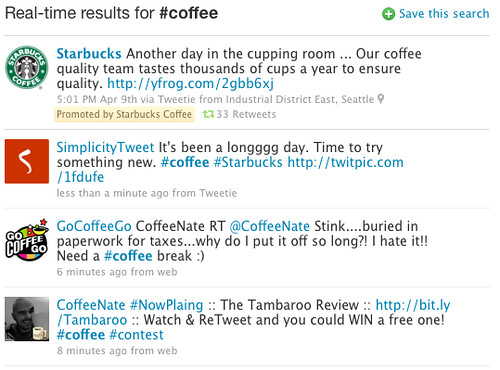
Twitter Unleashes Promoted Tweets Ad Platform

We certainly aren't first to break the story, but we think we deserve marks for thorough and accurate delivery.

Twitter has revealed their plans to slowly roll out advertising - first on their owned properties, then to third party platforms.

The question is how effective will the ads be in breathing fiduciary life into a non-monetized platform without jeopardizing the user experience. We like to call that trust. When a user no longer trusts a social platform, he or she will quickly move on. Don't believe us? One word: MySpace (*shudder*).

Our opinion is that the onus in now on the wizard behind the curtain at Twitter to protect the integrity of the service. Let's hope the nice folks at Twitter vet ads for content and substance, and only serve ads that equate to value for the target. 0.02% click-through copy ain't gonna cut it my friends.


So let's see what some of the majors had to say about Twitter's new ad platform...

The WallStreetJournal has a lengthy article and a feature video about the changes, but doesn't do much other than regurgitate the announcement.

The Huffington Post has an amusing array of user responses to the news that Twitter, like most things in the world, needs oxygen to survive. Beautiful green oxygen.

Mashable, the social media new juggernaut, and our old friend Ben Parr have a first-hand look at the launch of Promoted Tweets.

Finally our old standby AdvertisingAge channels Josh Bernoff to make a case for why you should advertise on Twitter.

Looks like we can expect a full roll-out with advertisers like Best Buy, Bravo, Red Bull, Sony Pictures, Starbucks, and Virgin America very soon. From what we've seen so far this is a platform like most others. It's going to be up to Twitter and it's partners to make sure things stay above board. Rest assured we will all be watching...

Follow us on Twitter!

Thursday, April 8, 2010

Tiger Woods' New Nike Ad Confuses, Makes Us Feel Sad

Tiger Woods' new Nike advertisement featuring the voice of his deceased father, Earl Woods, has a lot of people confused, and a few upset. What are your thoughts?

Saturday, March 27, 2010

Top Crowdscourcing Design Firms Review - 99designs

Crowdsourcing was one of those grey areas of advertising to keep your eye on in 2009. As employment worsens and more designers have discovered their freelancing legs, are we entering a golden era for crowdsourcing?

We have an extensive review of five top crowdsourcing companies from the perspectives of clients and designers. Let's get to it...


ADMAVEN Rates 99designs 3/5 for buyers

We liked the simplicity of the site - the second you enter the project creation area of 99designs you are presented with an intuitive interface that sets expectations (don't look for over 100 submissions if you are working on a tight budget). We were also reassured by the large, prominently placed 60 day money back guarantee touted during the project creation process. Security is a good thing.

We didn't like being charged extra for listing your project privately (intellectual property is a huge obstacle for many buyers - why ding us for wanting to protect our ideas?) or for a project that needs to be done in three days or less. We were also put off by the overall quality of submissions. But hey - it's an open crowdsourcing site - so we can't complain too much.


ADMAVEN Rates 99designs 4/5 for designers

We liked the low barrier to entry for designers - and the fact that each project (called a "contest" in 99 speak) tells us exactly what to expect - even if the buyer has already pl
aced money in escrow. We also enjoyed the social network features. These aren't particularly useful to designers trying to win a contest, but they do provide a simple way to share what you are working on with your friends.

We didn't like the hordes of amateur designers cluttering projects with concepts. We liked having a low barrier to entry, but this also means setting a low bar for design quality in many cases. Working for free is hard enough as it is - does every 15 year old with a pirated copy of Adobe Creative Suite have to be included too? We also took a slight issue with the very limited profile customization features. We want to have some portfolio work available directly on our profile - asking the customer to click outside the site to see our portfolio may be too much...

Sunday, February 14, 2010

The Innovation Engine Community

The last few months have been very busy for me - most of my efforts online have been placed in the new Innovation Engine Community. I suggest you check it out, register for an account, and join the discussion!

Tuesday, January 19, 2010

Maddock Douglas Acquires Change Inc.

Things are looking green around Maddock Douglas—and for good reason.

Maddock Douglas Acquires Change Inc banner

We recently signed a letter of intent to purchase Change, a Vancouver based consultancy focused on creating and branding green products and services. And with the closing date set for February 1, 2010, we’re ready to start innovating greener.

Check out the official press release on MaddockDouglas.com

“Why” might seem like a no-brainer, but the environment isn’t the only reason to be eco-friendly. Green is good for the consumer and our planet, true, but sustainability is now the key driver of innovation and, believe it or not, it’s also the ultimate competitive advantage.

And what exactly do we mean by that? Here’s why sustainability is more than planet-friendly:

CONTINUE READING

Wednesday, January 13, 2010

Social Media In 2010So far, 2010 has been the year of the tablet, the Blu-Ray, the e-reader, and 3D entertainment. These ideas represent fine consumer product innovations, but let's take a moment and talk about business models. The next year will see a host of changes for many large companies. One of the most interesting (and something we have had our eye on for years) is the integration of social technologies into large, and often siloed, organizations.


If you’re thinking, “wait a minute, I thought that was 2009,” think again. 2009 was indeed social media’s first year in the mainstream corporate consciousness, but for many, adoption has been slow and support has been the same.


Here's what you have to look forward to in 2010:

1) Social media won’t just be social media. That is, Social media in 2010 will no longer be a stand-alone feature. Instead of being the add-on garage, many innovative services and products will have social technologies built into business strategy. Social media will be used, not as a novelty, or an experiment, but as a strategic and integrated piece of a business unit. If we had it our way, the term "social media" would dissapear and simply be understood as a core operating principal of any successful organization.


2) Conversation will king technology.
Instead of focusing on spreading presence across mediums, (whether it be Twitter, Facebook or Linkedin) companies will begin to hone in on the most important part—the conversation. More in-depth efforts will be made to forge relationships, not small talk. Insights will be gathered with more efficiency and passed up the chain with more regularity.


3) Long-term will lead.
Throwing out tweets into the vast social media landscape with the hope that someone re-tweets or responds will be a thing of the past as marketers become better at crafting sticky messages. More in-depth (and ultimately fulfilling) interactions for the brand and the consumer will be far more regular than one-offs.


4) People will bolster relationships—not bots.
The companies that have the right strategy and implementation in place will, if they haven’t already, begin to interact with people as people—not bots, not nameless suits—people. In turn, company-consumer trust levels will increase.


5) Crowdsourcing will come with the territory.
People that are fans of products and services will help to police themselves—and companies will be more willing to allow the communities they are building to grow organically, ultimately facilitating consumer to corporate as well as consumer to consumer conversations with less interference.


Are your public relations professionals, marketing managers, agencies, and account teams still talking about social media one-offs? The most successful companies in 2010 will employ people who understand that social technologies have become a required practice and embrace these concepts as part of the job.


Have you seen the new Maddock Douglas homepage?


Follow Maddock Douglas on Twitter


Friday, January 8, 2010

YEO and ACE Founder Verne Harnish Talks Going Global and Getting Lean

Is your company ready to face huge opportunity? Verne Harnish, founder of the Young Entrepreneurs’ Organization (YEO), the Association of Collegiate Entrepreneurs (ACE) and founder and CEO of Gazelles, Inc. explains why productivity is key to going global and getting lean—and how it will change the game for good.


Verne Harnish - Go Global Get Lean from Maddock Douglas, Inc. on Vimeo.


Verne is a member of the Maddock Douglas Global Expert Network, an exclusive group of thinkers that includes entrepreneurs, professionals and specialists. GEN members span the globe and are hand picked to provide insight and expertise for specific opportunities and challenges. These experts often come from a parallel industry or have a specialized skill that relates to the challenge at hand. And this cross-section of thinking creates relevant, and frequently groundbreaking, ideas. Do you have a GEN? And if not, how do you plan to infuse outside expertise into your next big challenge?


Have you seen the new Maddock Douglas Homepage?


Follow Maddock Douglas on Twitter

Wednesday, January 6, 2010

Why Victims Can't Invent Anything - BusinessWeek

First, get past the fear of failure and unknown markets. Then stop complaining and blaze your own trail to innovation and profit

Consider this tale: Two salespeople for a leading athletic shoe company are sent over to a developing-world soon-to-be superpower country in the early 1980s. After a week of working to find leads, each salesperson reports back to corporate.


The first salesperson says, "Prospects could not be worse. Nobody wears athletic shoes over here."


The second salesperson sees things differently. "This is unbelievable! Everybody here needs our shoes!"


Question: Which report would have come back from you?


The answer is a simple way to determine whether you have what it takes to be a successful innovator. You are either a creator ("What an amazing opportunity—everyone needs what we have; we just need to figure out how to reach them") or a victim ("What a terrible situation").

Now you're probably thinking you are almost always a creator—never, or rarely, a victim. Well, here's how you know you are a victim: You complain about anything. That's right, the sure sign you are playing victim is complaining.

Here's why this should matter to you: In the world of innovation, there are only two kinds of people, victims and creators. Creators focus on finding solutions, welcoming the bumps along the way because they know overcoming hurdles will ultimately lead to a better solution. (More on that in a minute.)


Meanwhile, for victims, small problems—not to mention the inevitable big ones—lead to an unlikely addiction that keeps great ideas from happening.

Victims are Excuse Addicts

Perhaps you have uttered some of these words: The budget is too small; the deadline is too tight; the competition is too tough; my boss is a tool; my boss is an ignorant tool; legal won't approve it; R&D won't make it in time; my team is too small; we don't have any big ideas; we have too many ideas. Any of these sound familiar? Of course they do, because everyone developing new products and services has the same challenges. So why are your competitors—down the street and down the hall—besting you when it comes to new product development?
Put simply, they have learned failure is a positive part of being a creator and complaining is just the drug of choice for the victim. (And we want to acknowledge that The Power of TED, a book by David Emerald, got us to start calling these people victims.)
Failure is the Oxygen of Innovation


We are not being overly dramatic here. Failing is as much a part of creating as heavy breathing is a part of running. The trick is to understand that the creator sees every small failure as a big opportunity to modify the product or experience. They view every problem as an opportunity to come up with some creative workaround. For example:

• "R&D can't make it? I'll try to open innovation models and see if someone else can develop for us."
• "Budget is too small? I'll have online thought leaders expose it to their followers (for free) and take advantage of the viral lift."
• "This approach has never worked in the past? Well, gee. Maybe times have changed—and if they haven't, let's try a different way of attacking the problem."

Creators see the obstacles as springboards for new thinking, not as an excuse to throw up their hands and give up.


What is the Outcome You Want?

Okay, fine, you say. But what do you do if you have a victim mentality—if only once in a while—or manage people who do? Our suggestion is to ask this simple question when you (or the folks you are in charge of) confront an obstacle that makes you think about quitting: "What is the outcome you want?"


This simple question can magically turn a victim into a creator. This phrase is the beacon that allows you to navigate through political, budgetary, and scheduling waters.


Once you are clear on the destination, it becomes a lot easier to steer a course around obstacles and shoals.


If you manage a person who is constantly pointing to excuses when asked why the pipeline is slow or low, ask, "What's the outcome you want?" If that person can't create ideas to get there, he or she might just be too addicted to victimhood to innovate. And if you as a boss find yourself doing more complaining than creating, perhaps it's time to ask yourself the same question—and do something about it.

This article originally published in BusinessWeek

Have you seen the new Maddock Douglas Homepage?

Follow Maddock Douglas on Twitter