Showing posts with label microblogging. Show all posts

Tuesday, April 13, 2010

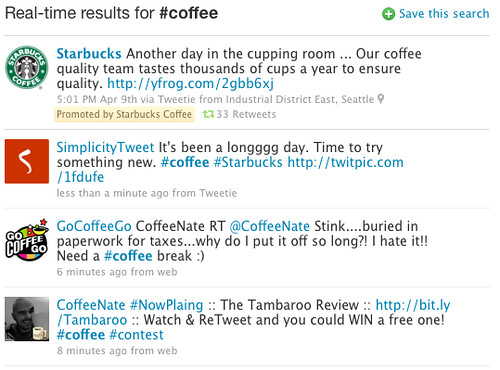
Twitter Unleashes Promoted Tweets Ad Platform

We certainly aren't first to break the story, but we think we deserve marks for thorough and accurate delivery.

Twitter has revealed their plans to slowly roll out advertising - first on their owned properties, then to third party platforms.

The question is how effective will the ads be in breathing fiduciary life into a non-monetized platform without jeopardizing the user experience. We like to call that trust. When a user no longer trusts a social platform, he or she will quickly move on. Don't believe us? One word: MySpace (*shudder*).

Our opinion is that the onus in now on the wizard behind the curtain at Twitter to protect the integrity of the service. Let's hope the nice folks at Twitter vet ads for content and substance, and only serve ads that equate to value for the target. 0.02% click-through copy ain't gonna cut it my friends.


So let's see what some of the majors had to say about Twitter's new ad platform...

The WallStreetJournal has a lengthy article and a feature video about the changes, but doesn't do much other than regurgitate the announcement.

The Huffington Post has an amusing array of user responses to the news that Twitter, like most things in the world, needs oxygen to survive. Beautiful green oxygen.

Mashable, the social media new juggernaut, and our old friend Ben Parr have a first-hand look at the launch of Promoted Tweets.

Finally our old standby AdvertisingAge channels Josh Bernoff to make a case for why you should advertise on Twitter.

Looks like we can expect a full roll-out with advertisers like Best Buy, Bravo, Red Bull, Sony Pictures, Starbucks, and Virgin America very soon. From what we've seen so far this is a platform like most others. It's going to be up to Twitter and it's partners to make sure things stay above board. Rest assured we will all be watching...

Follow us on Twitter!

Tuesday, July 28, 2009

Tweetsuits Multiply, Suing People For Tweets Going Mainstream

You may have read the story about St. Louis Cardinals manager Tony La Russa and his quest to sue Twitter over an impersonator's account. Recently that suit was dropped, though it marked a major reality check for the San Fransisco based micro-blogging service.

Now Chicago based Horizon Group Management has filed a $50,000 lawsuit against Amanda Bonnen, an individual with a paltry 20 followers, citing defamation for the following tweet:


The complaint filed in Cook County court states Ms. Bonnen "maliciously and wrongfully published the false and defamatory Tweet on Twitter, thereby allowing the Tweet to be distributed throughout the world."

Jeffrey Michael, representative of Horizon, is quoted in The Chicago Sun-Times as saying, "The statements are obviously false, and it's our intention to prove that. We're a sue first, ask questions later kind of an organization"

The Twitter account of Chicago resident Amanda Bonnen has since been removed, and it is now known that the removal was voluntary. Horizon claims they did not ask or demand that the offending tweet be taken down. In addition Ms. Bonnen is no longer publicly listed on LinkedIn or Facebook.

Daliah Saper, Principal Attorney at Saper Law, provides ADMAVEN with the following legal analysis:

"140 characters can be enough to defame - false statements proven so can certainly be grounds for a defamation suit. In an ever litigious climate, I'd think twice before publishing anything accusatory online, tweet or otherwise. A good rule of thumb when considering legal risk on Twitter is proof of claim: can you back up your tweet with hard facts? If you legitimately believe you are stating an opinion grounded in truth, then be prepared to state your case if you get slapped with a Complaint and Summons and cross your fingers that the Judge agrees your posting was merely an opinion."

The idea of a company suing an individual for defamation on the Internet is not new. The recording industry, and more recently the film industry, have been pursuing cases against individuals violating digital copyright law for years, and consequently have been vilified in mainstream media and social media outlet alike.

Is it really the best tactic for a brand to sue for these types of statements? One might say it is important to protect the integrity of the brand, but at what cost? At this point in time, Horizon Group Management has multiple mentions on Twitter and national news outlets.

In a world of democratized distribution of information focused the individual is it wise for a brand to come down this hard on someone with a mere 20 followers on Twitter? As more brands begin monitoring social media outlets for mentions, they will have a clear choice: work with consumers or against them. From a marketing and public relations perspective history has taught us that fighting the consumer seldom produces a net positive effect for the brand.

UPDATES 7/30/09

A couple of notable write-ups on the story from Social Media Today and Ars Technica.

Interact With ADMAVEN on Twitter

PEOPLE WHO READ THIS ARTICLE ALSO READ:

> Twitter 101: A Special Guide

> Social Media Helps Skincare Upstart Take on Big Beauty

> The Great Innovation Race! Building Online Advocacy With Twitter

Thursday, February 26, 2009

Defining Twitter - The Best User Tweets From #definetwitter

Nicholas Kinports (follow him on Twitter @ADMAVEN) has worked in the interactive technology world for over 15 years. He is the Digital Strategy Lead and founder of Chicago-based digital marketing firm lonelybrand, where he directs the creation and execution of digital marketing programs that generate measurable signups, conversions and sales.

What is Twitter? What is Twitter good for? How do you use Twitter? Why is Twitter so popular? How does a company use Twitter? How do you make money with Twitter?

Each day more people around the world are asking questions about Twitter. It's on the news, in local papers, and on business cards. Today, one of the top trending topics was #definetwitter. I have taken some of my favorite responses and posted them here to help you understand a little more about what makes Twitter so special.

You can find me on Twitter @ADMAVEN

richardpeacock : #definetwitter The only religion that answers back
Posted at 11:02 - View Tweet - Reply

wasatchwoman : a distraction from work...and a resource for my mag content. #definetwitter
Posted at 11:06 - View Tweet - Reply

JanetGomez : Twitter is about sharing with peeps you'll maybe never meet in person but with whom you feel a connection #definetwitter
Posted at 10:56 - View Tweet - Reply

Tom_Sweatman : Twitter is a perpetual regurgitation of mass perspective. #definetwitter
Posted at 10:51 - View Tweet - Reply

robert_brady : @unmarketing #definetwitter Twitter is whatever you can make it and whatever you want it to be. Why pigeonhole it?
Posted at 10:17 - View Tweet - Reply

LifeCoachMary : #definetwitter Twitter to me is like a virtual office cubicles by day. I can look over the virtual wall to get inspired, chat or learn.
Posted at 11:17 - View Tweet - Reply

eExecutives : Twitter is a place I can get and share ideas, insights, and fun just as they pop up... no lines, no waiting! #definetwitter
Posted at 11:27 - View Tweet - Reply

leximo : RT: @unmarketing: Twitter is where adults can type LOL and not be judged by their kids. #definetwitter
Posted at 10:54 - View Tweet - Reply

lachenmayer : Twitter is a great place to ask questions #definetwitter
Posted at 11:53 - View Tweet - Reply

AbbieF : Twitter is a buffet of information, take as much or as little as you want, as often as you want. #definetwitter

Monday, December 29, 2008

ADMAVEN On Twitter!

Nicholas Kinports (follow him on Twitter @ADMAVEN) has worked in the interactive technology world for over 15 years. He is the Digital Strategy Lead and founder of Chicago-based digital marketing firm lonelybrand, where he directs the creation and execution of digital marketing programs that generate measurable signups, conversions and sales.

Searching for the right blog material is a challenge - looking for the right tweets much less so.

I am actively pushing ADMAVEN Twitter, so those of you who enjoy a more regular (albeit smaller) broadcast from me should follow the tweets here:

http://www.twitter.com/admaven

Get useful social media and web 2.0 information, ask questions about your campaign planning, and contribute to future ADMAVEN articles.

I look forward to seeing what you are up to!

Thursday, August 28, 2008

Interactive Advertising Q&A Roundup

As an active member of communities touching the interactive advertising world I answer many questions on a daily basis. Each week I will round of some of the best questions and answers for your consumption.

Joy Abdulla asks:

How can social marketing be shown to be effective in terms of dollar sales?

Is there a mechanism/ method/formula through which we can effectively forecast or project what would be potential earnings for a brand by utilizing social marketing techniques on various sites?

ADMAVEN answers:

Joy,

The answer to your question is that you must have a third party software (or design your own) to measure the effects of your campaign. If the campaign is simple you may be able to track metrics yourself, but if there are any added layers of complication you will need extra help.

I have linked a company called Sway that does this very thing for many campaigns rooted in social media.

LINK: http://www.swayonline.com


Rich Dettmer, Director of Digital Strategy and Partner at Slack Barshinger, asks:

What law governs web based data collection?

When collecting data on a web site, is the collection governed by the laws of the country the data is collected from, or the country where the site is hosted? For example: If I am collecting user registrations from Europe on a site that is hosted in the United States, who’s laws govern that transaction?

ADMAVEN answers:

Hi Rich!

International law is tricky in the traditional corporate sense, but combined with the Internet there is very little case law to call upon.

The generally accepted concept is that you are governed by the place where your business is incorporated (whatever mechanism that may be). If you do not have a brick and mortar establishment, you may be subject to the laws of any country through which you transact. For example, collecting money from a UK citizen and storing that money in the United States exposes you to legal liability in both countries, however collecting data with no financial transaction most likely does not expose you to the country in which the individual providing the data resides. There is some case law along these lines regarding spam as a method of collecting data, and I do not recommend mass emails as a foreign campaign strategy.

In general the United States is a rules based country when it comes to law. You can review case law and find clearly (sometimes not so clearly) written torts, statutes, and laws that govern our businesses. In Europe (since this is in your example I will use it here) the laws are principle based. In other words, courts tend to look at your intent more than your action when deciding cases. If you are not doing anything blatantly illegal, I would say your liability is very low.

You can always seek council through an international attorney, but this is a costly engagement and may not provide you with a clearer answer.

I highly recommend contacting the consulate of each country in which you are interested to discover more about what your legal exposure may be. In my experience they are very helpful and willing to discuss these issues as well as the culture of their home country (which may help you formulate regional marketing strategies).

DISCLAIMER!

I am not a lawyer, though I do hold a Bachelor of Science in International Business and am almost through my MBA in the same subject. These kinds of questions appear in case studies and course materials. I hope my answer helped!


Laura Fitton, Principal and Founder of Pistachio Consulting, Inc., asks:

How can businesses use Twitter and other microblogging tools?

Communications, advertising, PR and social media agencies, what are your client's burning questions about Twitter and other "microblogging" platforms? Where do you look for the answers to what they should be doing?

ADMAVEN answers:

Laura,

Clients do not typically know about Twitter as a business tool. When appropriate, I may suggest microblogging as a way to engage a passionate target base.

The important thing when using Twitter - or any blog based tool - is to provide relevant content that is of interest to the target audience. Because Twitter is an opt-in service, target users must feel as though they are receiving something in exchange for their attention.

You can read more about how to use blog and microblog tools in ADMAVEN - The Interactive Advertising Blog, which I have linked below as a resource. Scroll down to the article entitled, "SEO vs. SMO Part 3: The Social Metropolis". Read the linked materials in the article and you will have a complete understanding of how to engage a target audience with a blog or microblog tool.

LINK: http://admaven.blogspot.com/2008/08/sem-vs-smo-part-3-social-metropolis.html


Natalia Alexandrou, Senior Marketing Executive at Report Buyer & Piribo, asks:

B2B Affiliate Marketing - does it work!?

I'm interesting in hearing your experiences (good and bad) with B2B affiliate marketing... and I'm not talking about the affiliate programs which use B2C tactics such as printer companies etc.

Are there any success stories? How did you approach possible partners? What tools work best for you?

We are a B2B company and we launched an affiliate program 5 months ago through a network with a dedicated campaign manager... and are only getting B2C affiliate sites joining our program. Is the industry just not ready to take on B2B affiliates?

ADMAVEN answers:

Ms. Alexandrou,

My experience has taught me several things about B2B Affiliate Marketing:

1) Pursue affiliates with whom you have a long and trusted business (or personal) relationship first. This may involve a C level meeting where you speak to the CEO, COO, and CTO to generate a list of companies that are willing to go the extra mile and form an affiliate relationship.
2) Be flexible. Although you should come in with a detailed plan on your Affiliate program, be willing to tweak the plan for each Affiliate. Every company is different, and applying one model to your targets may discourage them from forming a relationship.

When I started my B2B affiliate program, we went to our CEO and generated a couple of leads with whom we knew the CEO had maintained a personal relationship. These companies trusted our brand name, and were willing to at least listen. We then came in with our presentation, including the buy in figures, terms, etc... We had a contract ready to go, but never got a signature right away. Instead, we found the average time to close an affiliate was 6 months, and involved detailed negotiations with top management on both sides. Each deal was unique, but persistence and follow-up helped get the job done!

Nicholas Kinports (follow him on Twitter @ADMAVEN) has worked in the interactive technology world for over 15 years. He is the Digital Strategy Lead and founder of Chicago-based digital marketing firm lonelybrand, where he directs the creation and execution of digital marketing programs that generate measurable signups, conversions and sales.