Wednesday, June 30, 2010

Hulu Doesn't Understand Millennials: Why Hulu Plus Fails

Lately I feel like such a cynic. It's not my fault - honestly. It's the fact that major media companies can't seem to get it right when trying to connect with Millennials. From the big networks that own Hulu to record labels the trend seems to be taking old ad-based revenue models and trying to find ways to draw masses of people.

It's not just a problem of communicating product benefits, it's a fundamental failure to service unmet Millennial needs at the business model level. If you can't do that no amount of advertising will save your business.

Here's a few insights for advertisers seeking to connect their brand to this massive group of consumers (60 Million strong in the US alone. Source - Mintel):

Relying on Advertisers to Pay the Bills
Major media companies like NBC, Universal and Fox are still of the mindset that they should make money by creating video content and charging advertisers for placements. One problem: Millennials (and many others) don't respond to traditional advertising. Hulu may boast better response rates than television, but the margins are still too slim to support the costs of delivering streaming video to millions of viewers.

Mobility as an Afterthought
Many brands are guilty of a lackluster mobile offering: duplicating the web experience on mobile devices with no added benefits (often the opposite). Hulu plans to make the same content available via iPhone, iPad and others, but with little extra. Hulu mobile needs to be a comprehensive and proactive service to be compelling to Millennials. How about mobile alerts sent to your phone the second your favorite shows become available for viewing? Perhaps creating a mobile ad platform that requires advertisers to offer truly unique deals and discounts to opt-in subscribers.

Still No Social
The closest Hulu gets to a social experience is rating shows or sharing via email. This isn't enough - and certainly not for $10.00 per month. To survive and thrive Hulu must adopt comprehensive social technologies as part of the core experience. Chat rooms for shows, scheduling your own broadcast lineups for you and your friends to watch simultaneously as well as a mechanism to invite anyone through Facebook, Twitter, etc..., VoIP through Hulu (or through a partner like Skype) to share the experience of watching your favorite shows together. Those are just a few concepts that would be irresistible to Millennials and it took me all of 3 minutes to think of them.

Getting Everyone on Board
With networks like HBO, Showtime and Comedy Central clearly not on board with Hulu the result is viewers still have to hunt and peck around the web to find other shows they like. If Hulu can't get Comedy Central on board at least provide a sort of "universal web TV Guide" that links to or notifies Plus subscribers of exactly where and when an official web video goes live. Better yet - just do what it takes to get the real content on Hulu, in one place, so subscribers can get what they want, when they want it. Millennials demand instant gratification - remove that and you create one more point of friction.

Hulu Plus: Not Better Than Pirate Bay
When it comes down to the basics - and this is a subject that remains hidden in much of the commentary - Hulu plus isn't better than downloading shows from a Torrent search engine. These days most television shows (and even 18 Gigabyte Blu-ray movies) are readily available for download at no charge and in extremely high quality. You can take them anywhere, watch them on any device and keep them for life. Yes, it's technically illegal, but we haven't seen any real backlash from broadcasters or ISPs as of yet. The point isn't to advocate piracy. It's to give Hulu a reality check - why would Millennials pay for something they are getting free elsewhere?

Let's talk about implications for the agencies and developers creating rich advertising content for services like Hulu. Be warned - your clients' days may be limited by their inability to connect with the very group that should be bringing them the most revenue. Competitor services that understand Millennials are out there and growing. Without substantial change in the service offering, Hulu has a high potential for failure in the next two years.

Nick Kinports (follow him on Twitter @ADMAVEN) has worked in the interactive technology world for over 9 years, and helps the Fortune 100 identify unmet consumer needs, create ideas to fill those needs, and bring them into market. He currently works at Maddock Douglas.

Monday, June 28, 2010

iPhone 5 and Beyond: Top Trends in Smartphone Technology

It's an exciting time to be working with mobile technologies. iPhone 4 has reportedly sold over 1.6 Million units on it's first weekend in stores, making it one of the most successful mobile device launches ever.

Here's five thoughts on what the next big leap in smartphone technology will bring to the table:

Glasses-Free 3D
With the recent 3DS announcement from Nintendo it's pretty clear that portable, glasses free 3D is a reality. It was noted, however, that Nintendo couldn't figure out a way for touchscreen and 3D technology to "play well together". I'll admit - I'm having a hard time visualizing what a 3D touchscreen would look or feel like from a UI perspective - but I'm also willing to bet someone is hard at work on a next-gen 3D smartphone.

It's The Network
iPhone 4 has been unanimously received as the best mobile device out there. The AT&T network that comes with it? Not so much. Verizon and other carriers seem to be both learning from AT&T's mistakes in capacity and failing to learn from their pricing strategy (which I still believe is a mistake). For consumers it all adds up to a giant, and often expensive, headache. In my opinion the network is the final great pain point for smartphone customers, and it won't be long before a carrier breaks out of the doldrums and brings a high capacity low cost service to market. UPDATE 6/28/10: looks like President Obama is on-board with the future.

Sync My Life
What if your phone was always pinging, relaying data back and forth about your location, activities and availability. We're close right now with services like Loopt and background tasks (finally available on iPhone in OS4). The next step? Complete automation combined with a healthy dose of privacy controls. Want to know how many steps you took today or how many friends you came within 100 feet of? How about keeping track of your habits and schedule without opening apps?

Reality Plus
Augmented reality has been openly discussed as a game changer. So far we haven't seen a killer app. Carrying a powerful smartphone means a lot of things - including advances in miniaturizing complex processors and components. It won't be long until we see device manufacturers selling visualization aides as part of the package. These could be glasses that tap an owner's smartphone for data or contact lenses that display key information. It may be fringe technology today, but it could satisfy the demand for augmented reality that's always on and doesn't make you look like an idiot walking around holding your phone up to everything you see.

I Love Advertising
Nobody likes being disrupted from making a phone call, browsing the web or watching their favorite television show. With mobile devices that are constantly aware and in sync to the owner's reality look for deeper, highly targeted advertising experiences. The line between advertising and serendipity will begin to blur, and your phone will know "that it's been six weeks since you had a decent haircut and even though you are traveling on business there's a great barber shop right around the corner offering a discount to new customers that fits your typical spending habits and by the way: you have enough time to go in before your next meeting." Most of the data required to make the above connection already lives in your digital world - it only requires a step up to connect the dots.

As new smartphone devices are announced every week and the market expands at a faster and faster pace, what are your key predictions for smartphone and interactive advertising technology?

Nick Kinports (follow him on Twitter @ADMAVEN) has worked in the interactive technology world for over 9 years, and helps the Fortune 100 identify unmet consumer needs, create ideas to fill those needs, and bring them into market. He currently works at Maddock Douglas.

Wednesday, June 23, 2010

Do We Need a Social Media Bill of Rights?

I received an outreach email from the authors of Wild West 2.0 detailing their proposed social media bill of rights. Here's the summary followed by my analysis:

The Social Media Bill of Rights
By Michael Fertik & David Thompson, Authors of Wild West 2.0: How to Protect and Restore Your Online Reputation on the Untamed Social Frontier

As social networks have grown in importance, ReputationDefender has seen a shocking pattern of privacy violations, ranging from inappropriate data sharing to attempts to trick users into revealing their personal information.


It is time users took back control of their online privacy. ReputationDefender presents this draft Social Media Bill of Rights to provoke thought about how social networking sites -- like Facebook, MySpace, Twitter, and others -- should treat users and protect privacy. We strongly believe that social networking sites should recognize and grant each of these rights to users in an open and transparent way.

Social Media Users Have These Rights

1) The right to privacy.

When in doubt, privacy comes first.

By default, users should not expose information to the world, to data brokers, to corporations, or to anyone else.

Users have the right to share as much or as little as they want. They are in charge of their privacy, and all data sharing comes only after user consent.

2) The right to choose.

Privacy settings must be easy and understandable. If your parents can't use it, then it's not simple enough.

Privacy controls should be easy to find. Social networks should put privacy controls next to where they are needed; near photos, near data collection portals, and other places where users expect to find them.

If taking an action (installing an app, using a new feature, etc) will expose or share data, users deserve to know before they commit. Social networks should explain the privacy cost of each new feature, and let them make an informed choice.

Interfaces should not be evil. Each interface should clearly communicate the privacy consequences of each action. Interfaces that collect or use data in a non-intuitive way should be clearly labeled and explained.

Any kind of external data sharing should be opt-in, not opt-out. If it's so useful, it will be easy to convince users to sign up. Outside corporations don't have a right to user information without clear user consent.

3) The right to data minimization.

Just because a social network can, collect information doesn't mean it should. Social networks should strive to collect no more information about users than what is required to present social functions.

Storing "click stream," "search history," and other data that is not directly tied to social functions is often an invitation to privacy invasions. Storing this data does not directly enhance user experiences and often violates user expectations.

When in doubt, aggregate. Aggregated data often fulfills the same function without the privacy risks.

We don't know the long-term consequences of mass-scale data collection and storage; it is better to err on the side of caution and data minimization.

4) The right to honest communication.

Users have a right to know how their information is being used. Tell them. Use language you'd use with friends, not language used by lawyers. Agreements should be easy to understand and not contain hidden legalese.

If something goes wrong, tell users openly and honestly so that they may protect themselves.

If aggregated data turns out to not be anonymous (like the Netflix Prize data set), tell affected users. Openness today will save headaches tomorrow.

Even if the lawyers can find a legal loophole, users deserve to be treated with respect; social networks should treat users as they expect to be treated, not at the minimum possible legal threshold.

5) The right to delete.

Users have a right to leave social networks. When they do, they should be able to easily take back their data too.

The right to delete includes deleting any marketing information or dossier that has been compiled about them, including any behavioral advertising data.

Exceptions are permitted for financial transactions and other records that must be kept for legal compliance.

6) The right to know.

Users have the right to know:

* how information about them is being collected;
* to whom their data is being sold;
* how their data is secured;
* how many people can see their personal information;
* when there are data security incidents, even if they don't trigger existing notification laws.

Disclosures should be in plain language.

If data is being collected in non-obvious ways (click patterns, through offline sources, etc) then it requires special notice.

7) The right to dignity.

Some information is too personal for social networks to demand or share. Even if it is possible to find out intimate secrets of users' lives, it is usually best to not.

There are limits on the wisdom of behavioral and contextual advertising, even if users have agreed to it. Social networks should think twice before trying to profit from their users' grief, weaknesses, or personal failings.

Social networking engineers should always ask themselves, "would I want my data to be used this way?" If not, don't code it and don't implement it.

Sites should not encourage users to debase, defame, or abuse each other. There is always another person at the other computer; remind users to treat each other with dignity.

8 ) The right to accountability.

Social networking sites should be willing to undergo regular privacy audits to prove they are using data only in approved ways. Sites that don't allow privacy audits should be considered suspect.

Leaders of social sites should accept personal responsibility for the security and privacy practices of their sites. If they make a false promise, they should be held personally accountable.

9) The right to not participate.

Users have the right to not participate in social networking. If they choose not to, social sites should not compile a dossier or file about them, even if friends volunteer that data.

Non-users should be able to find out how personal information about them is being shared or discussed (including "tagged" photos or facially-recognizable photos) without providing further personal information.

10) The right to social privacy.

Social networks should make it easy for users to help friends be respectful of privacy.

Social networks should not encourage users to violate each others' privacy. Interfaces that encourage prying or over-sharing are disfavored.

Social networks should allow users to contact each other about potential privacy violations and privacy requests. A simple "I'd prefer this photo not be online" notification system can help friends communicate their preferences without threatening free expression or creativity.

I generally agree that social networks have shady privacy practices. We've all seen the recent Facebook privacy gaffs (probably the tip of the iceberg). But do consumers really care? Are Millennials, for example, overly concerned how the data they voluntarily upload using social technologies is used by advertisers? Tell me what you think.

Nick Kinports (follow him on Twitter @ADMAVEN) has worked in the interactive technology world for over 9 years, and helps the Fortune 100 identify unmet consumer needs, create ideas to fill those needs, and bring them into market. He currently works at Maddock Douglas.

Tuesday, June 22, 2010

Universal Music Group Expects Millennials to Pay for Music, Wants Government Pressure on ISPs

Yesterday I received an open letter from Jim Urie, CEO of Universal Music Group Distribution (UMGD), the distribution arm of the world's largest music company. In his letter Jim reveals his plan to encourage ISPs to regulate illegal downloading of music and compensate the music industry with a viral campaign. Read his letter followed by a quick reality check from me.

Dear Nick,

I’ve received hundreds of e-mails enthusiastically reacting to my “call to action” at the National Association of Recording Merchandisers convention last month. The music business is facing huge challenges from piracy and theft. Never before in American history has an entire industry been so decimated by illegal behavior. Yet the government has not responded in a meaningful way to help us address this crisis. My call to action is for all of us to become more aggressive in lobbying our government, more outspoken in drawing attention to the problems caused by piracy and more actively engaged. We cannot win this fight alone.

Governments outside the U.S. are legislating, regulating and playing a prominent role in discussions with ISPs (Internet Service Providers). Sales have dramatically improved in these countries. How is it that the U.S. – with the most successful music community in the world – is not keeping up with places like South Korea, France, the UK and New Zealand?

As I said in my speech, I hope that the industry can negotiate a voluntary deal with the ISPs. We need our government representatives to encourage this. But whether or not we reach a deal with the ISPs, our government needs to know that we’ve got a piracy problem and we need real solutions. To accomplish this, our government needs to hear from all of us, so they know that their constituents are out here. Join me in calling on our elected officials to fight piracy. Please help by forwarding this email to your colleagues, friends– everyone who loves music. And consider enlisting your entire company to help in this fight. Then by clicking on the link below a message will be sent to your representatives in Washington. Help us launch a viral campaign to cut off access to the online sites that are used to steal our music, our property and our jobs. In only takes a second but it can make a tremendous impact.

Click HERE.

Please help us by forwarding this link.

Sincerely,
Jim Urie
Learn More at www.musicrightsnow.org


Let's get some facts straight.

The Millennial generation (born 1977-1994) doesn't like to pay for things that can be downloaded or streamed for free.

Music falls into that unfortunate category of products. Books and publications are meeting the same fate. This trend isn't changing at all - in fact it's accelerating as mobile and cloud computing becomes more prevalent.

You can't force Millennials to pay for music again.

It just won't work. The model is forever broken. Market and sales data supports this conclusion and most of the major music companies know it. Attacking ISPs and trying to force their hand won't work either. ISPs have a working revenue model and a product that still holds value to Millennial consumers.

There is a better way.

I encourage anyone who is struggling to come to grips with declining revenues from digital music downloads to rethink engagement with Millennials. It's time to work with them with the realization that you won't be able to pry open wallets with your existing business model. That's right; I'm telling you that you will never make money again by selling music under your current distribution model. A top down industry reinvention is required. So far I haven't seen a major label take a step in the right direction. The first music company to do it will win big.

I invite anyone from UMG to email me for a constructive conversation off the record about the future of the music industry.

What do you think? Can Universal Music Group kick off a revival of a dying business model through regulation? Will you participate in their viral campaign?

UPDATE 7/6/10: Prince decides "the Internet is over" and shares some cooky wisdom about why digital is "no good".

Nick Kinports (follow him on Twitter @ADMAVEN) has worked in the interactive technology world for over 9 years, and helps the Fortune 100 identify unmet consumer needs, create ideas to fill those needs, and bring them into market. He currently works at Maddock Douglas.

Thursday, June 17, 2010

Social Media: Activism Killer?

I've written before about the dangers of mistaking social media involvement as activism for a cause (or a brand for that matter). Here's a short segment from CBC describing the new campaign from Greenpeace aimed at re-branding BP with a, shall we say, more appropriate logo and a green expert that thinks it's all "a bunch of crap".


Does social media serve as a public "energy sink" for brands in crisis? Is BP actually benefiting from the negative social media outcry?

Nick Kinports (follow him on Twitter @ADMAVEN) has worked in the interactive technology world for over 9 years, and helps the Fortune 100 identify unmet consumer needs, create ideas to fill those needs, and bring them into market. He currently works at Maddock Douglas.

Wednesday, June 16, 2010

Millennials Spend More Time and Money On Smartphones, View Them As Competitive Advantage

There's a trend happening in the Millennial consumer segment that needs to be called out directly. It's been happening for a while now, but recently I believe leaps in smartphone technology have dramatically accelerated unmet consumer demand for smarter, faster and more usable mobile devices.

For the Millennial workforce smartphones are now a competitive advantage and a perquisite to successful adaptation.

But wait, haven't smartphones been a staple of the professional workforce for the last five years? You bet. But until now the trend has largely applied to corporate email. Blackberry devices paved the way for an entire generation to be on the clock twenty four hours per day. That's great (or not so great if you enjoy uninterrupted downtime) but what I'm talking about is fundamentally different.

When AT&T and Apple opened for iPhone 4 pre-sales on June 15th, 2010 their servers were immediately crushed by an influx of traffic. You've probably read the stories by now. The end result? Apple and AT&T completely sold out of iPhone 4 in pre-sale. AT&T made this statement:

"In addition to unprecedented pre-order sales, yesterday there were more than 13 million visits to AT&T's website where customers can check to see if they are eligible to upgrade to a new phone; that number is about 3-times higher than the previous record for eligibility upgrade checks in one day."

I'm using iPhone as an example of the trend accelerations I've described before and seen on other recent device releases, notably a bevy of Android smartphones.

Great. So what does it mean for brands and advertisers?

It's finally time to tap the masses of notoriously hard to reach Millennial wallets, and smartphones will provide the bridge to do so. Average time spent on these mobile devices is about to go up. Way up. When selecting ad platforms, look for those that are providing superior experiences. The future of these systems has already been solved in other parts of the world, and though all markets are different, it won't hurt to take a look outside your borders for inspiration. The smartest marketers will be ahead of this already fast-moving trend - shifting significant budget to rich and innovative mobile advertising before the research reports hit.

Nick Kinports (follow him on Twitter @ADMAVEN) has worked in the interactive technology world for over 9 years, and helps the Fortune 100 identify unmet consumer needs, create ideas to fill those needs, and bring them into market. He currently works at Maddock Douglas.

Tuesday, June 15, 2010

Facebook Fan Value: The Definitive ROI Formula

Ready for the definitive ROI formula to calculate how much every online social interaction is worth?

There isn't one. And you should stop wasting your time trying to figure it out.

Before I tell you why let's look at a couple of tips and case studies to make your marketing efforts more valuable in the the current social technology landscape:

Incentivize sharing across your target platforms. A great case study for this type of engagement is Urban Hunt. Sponsored by FIJI Water, participants in the day long contest are required to open their social profiles (making your wall public on Facebook, etc...) and post bits of information including YouTube videos, status updates, check-ins, Tweets and more to earn points in the event.

Integrate the experience into an every day social activity.
Have a look at Bartab. This iPhone app allows you to purchase and send drinks virtually. Participating bars will then sell the real drink to the recipient for $1.00 (a steal in San Francisco - the only participating city at the time of this article). The catch? The only way to get the drink is by allowing Bartab to openly share on Facebook and Twitter that you have sent or received the drink.

The conversation needs to be less about a hard ROI for "fans", "likes" or "check-ins" and more about driving engagement and brand equity with things worth sharing. Let's face it, spending time trying to calculate these figures is futile; before you know it the private companies that own major social platforms are going to commoditize social sharing and pull the rug out from under marketers' feet. I've been saying it for months now, and trust me, it's coming sooner than you think.

The best way to bring social value to your (or your clients') brand(s) is through creation of a unique and highly incentivized sharing experience. Contests and gimmicks are old hat and boring. Consumers demand more interesting, interactive and inherently social applications. Based on accelerating trends it shouldn't be hard to identify that next killer campaign for your brand.

As for measurement? I wouldn't worry too much about the details. Use analytics layered over interactions and revenue to get a good picture of success or failure. Make great social applications that share and scale well and you'll find measurement becomes far less important in the grand scheme.

Nick Kinports (follow him on Twitter @ADMAVEN) has worked in the interactive technology world for over 9 years, and helps the Fortune 100 identify unmet consumer needs, create ideas to fill those needs, and bring them into market. He currently works at Maddock Douglas.

Wednesday, June 9, 2010

3 Interactive Advertising Trends iPhone 4 Will Accelerate

If you're an Apple enthusiast your world ground to a halt on June 7th, 2010 at 12:00CST for the live announcement of the iPhone 4 (among other, and decidedly less hyped, technologies). Of course most of us had already seen a prototype model leaked (lost) months earlier.

I don't really care about the specifics of the phone itself, and won't bore you by rehashing some of the same old points about how amazing and magical the device is. Instead let's take a look at the trends that the ubiquitous device will accelerate in the interactive advertising space.

First, a disclaimer and an opinion. I own an iPhone and enjoy the experience. I do have my complaints, but overall it's the one piece of tech I couldn't live without on a daily basis. The opinion? iPhone isn't going anywhere. In fact, for the reasons I'm about to outline below, iPhones are going to become even more relevant in the average smartphone user's life.

TREND ACCELERATION: Video Everywhere

Advertisers have, for years, struggled with making video relevant and engaging. Consumers, for the most part, haven't jumped on the bandwagon. Video widgets and ads have actually become less prevalent as advertisers adjusted budget from expensive production to Google ads embedded in YouTube. That's all over now. Watch and see.

TREND ACCELERATION: Mobile Ads That Work

iAd is a great advancement in mobile advertising technology, but the real insight here is ubiquity of a single mobile platform. That means advertisers, agencies, and marketers can begin to think about one mobile culture instead of disparate pockets of early adopters. We've all heard mobile ad budgets are on the rise and will reach seventy three quadrillion dollars by 2052, but the reality is that iPhone 4 and OS 4 will accelerate this process dramatically.

TREND ACCELERATION: Rich Social Ubiquity

Social technologies have come a long way in the last few years. It's generally accepted that some of the more robust technologies like video blogging, podcasting, and lifestreaming haven't caught on the same way that Facebook or Twitter has. Thanks to the ease of use of Apple's new mobile device, expect to see the traditional blog (and to some extent microblogging) made less relevant as it's eclipsed by richer formats.

Do you see iPhone 4 as a catalyst for trend acceleration? What else do you see coming down the pipe as Apple's next big device hits market?

Nick Kinports (follow him on Twitter @ADMAVEN) has worked in the interactive technology world for over 9 years, and helps the Fortune 100 identify unmet consumer needs, create ideas to fill those needs, and bring them into market. He currently works at Maddock Douglas.

Thursday, June 3, 2010

Wild West 2.0 Book Giveaway

Does the thought of online reputation monitoring and crisis management give you the chills? Do you REALLY know who is out there wreaking havoc on your personal reputation or brand?

Wild West 2.0 aims to not only scare you into realizing that you need a beefier social media presence, but gives you some tools and tips to clean up and manage your image.

I'll be giving away the hard copy edition of "Wild West 2.0, How to Protect and Restore Your Online Reputation on the Untamed Social Frontier" on Thursday, June 10th 2010. To enter for a chance to win, subscribe to ADMAVEN by email. Don't worry - you'll never receive spam or unwanted garbage. By signing up today you'll also make yourself eligible for future giveaways and contests! Just fill out the form in the upper right corner of this blog, or use the handy form below. Don't forget to verify your email address once you sign up - only verified registrants will be considered! Winners will be notified by email at the address with which they are subscribed.


Enter and verify your email address for a chance to win "Wild West 2.0":


Nick Kinports (follow him on Twitter @ADMAVEN) has worked in the interactive technology world for over 9 years, and helps the Fortune 100 identify unmet consumer needs, create ideas to fill those needs, and bring them into market. He currently works at Maddock Douglas.

Wednesday, June 2, 2010

AT&T Gives The Future The Finger, Announces New iPhone Data Pricing Plans

AT&T has announced their new pricing structure for data on iPhone well in advance of the 4G release and OS 4.0.

The gist of the program? You'll probably be spending a lot more time worrying about something that should have been included from the start.

You must be thinking to yourself, "No way! I'm not a heavy data user. I won't be going over 200MB a month so I'll be saving in the end." That may be true. Before you write me off sign in to your att.com account and review your data usage for the last 5 months.

Here's mine:
No, that isn't an error. In December I activated tethering, the much anticipated but never delivered feature that allows an iPhone user to turn their device into a modem, allowing laptops or other USB and Bluetooth compatible devices to access the internet through the iPhone's 3G signal.

I travel 20-30% of the time, and tethering was a perfect solution to the endless search for a high speed connection. Too bad that my usage will cost me an extra $75 per month, bringing my already ludicrous monthly AT&T bill to $200.

Steve Jobs recently addressed network concerns (not data plans). Clearly Apple is in the same camp. AT&T wasn't ready from a network perspective, and you can bet that despite Jobs' calm demeanor he is fuming about the lack of progress from AT&T's end.


Some choice quotes from Jobs:

"I know little about this stuff [wireless networks] technically. This is not my area of expertise. To make things better people reallocate spectrum."

"Things in general, before they start to fix them, get worse before they get better. That's what I am told."

"A lot of things are going to get better by the end of Summer."

My opinion on the entire matter is that AT&T has failed in two regards. From a network perspective they failed to anticipate the level of data and call volume that an exclusive contract with Apple would generate. It's clear their network can't handle it, and their solution is to build disincentives in for heavy 3G data usage.

From a customer relations perspective AT&T has failed to admit their blunder. Just come out and say, "Hey guys - we messed up! We thought we had a network that could handle such heavy use, but it wasn't the case. We are fixing it, and here's when you can expect that fix. In the mean time we aren't going to punish you for using your device as intended, just realize that service may not be that great in certain areas and during certain times."

This is to say nothing for the near future. As Apple continues to roll out new products and services (iAd and iPhone 4G with video conferencing anyone?) the norm for data usage will shift.

If you made it this far I'll just deliver my point: AT&T may be creating a business model that goes against the grain. As cloud computing, streaming video and audio, VOIP, video conferencing, MMS, and other technologies become mainstream 200MB a day won't be enough. Apple has little patience for companies that impede their progress, so I have to wonder if AT&T isn't shooting itself in the foot. What do you think?

Nick Kinports (follow him on Twitter @ADMAVEN) has worked in the interactive technology world for over 9 years, and helps the Fortune 100 identify unmet consumer needs, create ideas to fill those needs, and bring them into market. He currently works at Maddock Douglas.

Monday, May 31, 2010

Should Consumers Be Paid For Using Facebook?

The reports of The House Judiciary Committee's letter to Facebook are, for the most part, unsatisfying. Rep. John Conyers Jr. (D-Mich.), chairman of the House Judiciary Committee, has been quoted as saying, “Companies such as Facebook and Google provide innovative services that enrich and expand the constantly evolving Internet. I want to ensure that privacy concerns are as paramount as creativity to these and all Internet companies, and I look forward to hearing about ways they can ensure this is the case.”

I want to take a moment and share my thoughts about the bigger picture. No, Facebook isn't in trouble, and it isn't likely that the Committee's inquiry will have any effect on revenue or future plans for deployment of advertising services. As marketers we need to ask ourselves a few questions from a consumer perspective:

Is the temptation to share too great?

The allure of social networking is obvious and indisputable. Sites like Facebook tap into a primal need to communicate, find others like ourselves, and form relationships at a faster pace. It's tribal, and it's human, and in the end we can't really help ourselves.

Is our privacy an unfair trade?

Because we can't resist giving up much of our private data to companies like Facebook, we rarely stop to ask ourselves what the value of our personal data really is. It's worth posing the question:

Do we really know how much our information is worth?

If the value of our personal data far outweighs the benefits offered by a site like Facebook (from a financial perspective) why aren't we doing more to capitalize on that market - effectively creating a valuation system for our online behaviors. For more on what that might look like, read "Facebook: The Currency of Like". It raises yet another question:

Should Facebook be paying users to share their information with advertisers?

In the end, the House Judiciary Committee's letter to Facebook is about fair valuation and compensation for private citizens' data. Though it may be true that people all over the world are voluntarily feeding data to Facebook with the full disclosure in Terms of Service for what may or may not happen to that data, it's also true that most users can't imagine a future where their data is used in a way that becomes undesirable. As Facebook pushes toward bigger profits (and, as I have said many times before, the larger goal of an IPO) there will be a sharp uptick in the number of malcontents.

Keep this in mind as you plan your brand's push into social networks. It may be the Wild West today, but there will come a time when things change - be it by privatized hands or government mandates. I, for one, can easily see a future where the dominant social network pays users fractional amounts when their profile data is sold to advertisers; seems fair to me...

How did you interpret the inquiry to Facebook from The House Judiciary Committee, and what do you think will happen next?

Nick Kinports (follow him on Twitter @ADMAVEN) has worked in the interactive technology world for over 9 years, and helps the Fortune 100 identify unmet consumer needs, create ideas to fill those needs, and bring them into market. He currently works at Maddock Douglas.

Thursday, May 27, 2010

Are RSS Feed Readers Irrelevant?

Lately I've been thinking about RSS Feed Readers.

Subscription analytics from the communities I manage, digital properties I own, and input from people who are in the know all point in the same direction:

Feed Readers have become irrelevant.

I'm interested in your input as well as your hypothesis. Why has email dominated feed readers for subscription rates? Let me give you an example:

Two months ago I noticed ADMAVEN had been losing traffic from feed subscribers. I installed email subscription code (check upper right corner) to see what would happen. Now over 60% of my active feed subscribers receive their updates via email.

I manage the Innovation Engine Community. After working through the analytics, it's clear that under 5% of the Community's thousands of active members get updates via RSS Feed Readers.

Is it time to kill the RSS reader subscription links that have become so prevalent on the web and replace them with email forms or other, similar technologies? What has your experience been, and how have you changed tactics to give your readers what they want?

Nick Kinports (follow him on Twitter @ADMAVEN) has worked in the interactive technology world for over 9 years, and helps the Fortune 100 identify unmet consumer needs, create ideas to fill those needs, and bring them into market. He currently works at Maddock Douglas.

Tuesday, May 25, 2010

BP's New Stance on Social Media Crisis Management: Let it Ride!

About a week ago I asked how BP will handle the coming firestorm of social media parody, impersonation, and intellectual property infringement.

As of yesterday we know the answer.

As the faux @BPGlobalPR Twitter account heats up with tens of thousands of followers and a clothing line, I see a trend forming.

Empathizing with and supporting victims has always been a tactic of crisis management. BP has taken this to the next level by allowing branded co-creation of content and merchandise to take place.

In a way, BP has endorsed negative (and arguably illegal) social media behavior by omission.

Here's an interesting question:

What if BP had a hand in creating the parody content?

It stands to reason that angry consumers feel a little better if they are following what they perceive to be a parody Twitter account and participating in the conversation. BP's position seems to be indifference.

Toby Odone, a spokesman at BP, told Ad Age of the parody Twitter account, "People are frustrated at what's happening, as are we, and that's just their way of expressing it."

Another quote comes to mind... Put you geek hats on:

"If you strike me down, I shall become more powerful than you could possibly imagine."

Nick Kinports (follow him on Twitter @ADMAVEN) has worked in the interactive technology world for over 9 years, and helps the Fortune 100 identify unmet consumer needs, create ideas to fill those needs, and bring them into market. He currently works at Maddock Douglas.

Saturday, May 22, 2010

When Budget Doesn't Matter

This is how you make a video spot...

Nike's "Write The Future" campaign:

Anyone have a cost estimate for this monster?


Nick Kinports (follow him on Twitter @ADMAVEN) has worked in the interactive technology world for over 9 years, and helps the Fortune 100 identify unmet consumer needs, create ideas to fill those needs, and bring them into market. He currently works at Maddock Douglas.

Thursday, May 20, 2010

Online Ad Revenue Set to Explode, As Marketers Struggle With Complexity Who Wins?

Facebook, LinkedIn, AdWords, countless networks, and now Twitter. These are just a few of the major online advertising platforms agencies, marketers, and entrepreneurs are budgeting for in 2010 and 2011. According to Nikesh Arora, Google's president of global sales, the budget allocated to online advertising is about to skyrocket.

I agree.

In an age where traditional media is in the throes of a long and painful death and more of the world spends time online Mr. Arora's estimates are well taken. He states,

"People are shifting their spending dollars more and more to the online world – whether it be direct marketing, or advertising, or branding. And that follows industrial marketing logic which is that you have to go where the eyeballs are, where the customers are.

The next big wave will be consumers consuming more and more video on the web, and you will see more and more brand advertising and display advertising move to the web."

There's just one problem: Most marketers don't understand online ad technology.

I'll admit - I have a lot to learn, but based on some impromptu research of major North American Brands marketers have a long way to go. Take this statement as an opinion only for now; I'm not prepared to present the hard facts on what's out there.

All things considered, here's my prediction of who will cash in and why:

Twitter: the hugely popular microblogging service is about to unleash it's ad platform. I think the concept is simple enough that marketers will flock to the service... at least in the beginning. From a long term viability standpoint I don't see Twitter generating the kind of revenue it needs to be profitable from ad sales. Not to be a pessimist, but I have witnessed the decline of Twitter in the consumer marketplace, and I can't imagine a future where inundating consumers with sponsored Tweets and ads will make the service more palatable.

Facebook: the world's most popular social network has visions of becoming bigger still, and in order to accomplish Facebook's goal of going public (trust me - this IS a priority no matter what Facebook is saying publicly) they are going to have to have some serious revenue on the books. Ad sales are going to make up a big part of this, and I think the next big wave on online ad spending will see Facebook cleaning up as it expands it's semantic web approach. The "Like" button, among other widgets and games will increase the importance of Facebook - and it's value to advertisers.

Ad Networks: though Facebook will get a healthy bump in revenue from selling advertising, it will be dwarfed by the increase in sales through ad networks. As semantic, geo, and behavioral targeting become more refined (and more intrusive) expect the immediate benefits to be irresistible to advertisers looking to squeeze more out of an already reduced budget (raise your hand if you had a healthy increase in your marketing budget over the last 2 years... Beuller? Anyone?).

Video Services: YouTube and others will reap big benefits in online ad revenue from a sharp increase in online video viewing.

What other trends are you observing in the online ad space?

Nick Kinports (follow him on Twitter @ADMAVEN) has worked in the interactive technology world for over 9 years, and helps the Fortune 100 identify unmet consumer needs, create ideas to fill those needs, and bring them into market. He currently works at Maddock Douglas.

Wednesday, May 19, 2010

Fixing the Music Industry, One Viral Video at a Time

If the late 90’s and early 2000’s were about scandalously clad underage girls becoming pop sensations, the second decade of the new millennium is most certainly starting with youthful boys belting out shrill tenor chords on YouTube.

It’s about to be common knowledge that Canadian born Justin Beiber has the top selling US record for the week of May 9th – the same week that other, and certainly more “adult” sounding artists pitched their wares through more traditional channels. Add to that the fact that the number of Beiber’s units sold is abysmally low. It’s just another nail in the coffin of an industry that is currently seeing the downside to rejecting progress.

Beiber’s meteoric rise to fame
is another, and for marketers old, YouTube story. You know it just as well as I do – talented kid thinks it would be cool to put his videos up on YouTube, does so, and is plucked from a normal childhood by a bevy of talent scouts, agents, and record labels who come late to the game after seeing huge numbers of video views.

Greyson Michael Chance is the latest in a long line of child artists to be snapped up by Hollywood – moving from a YouTube viral phenom to guest of the Ellen show in three days. Wikipedia hasn’t even decided if he’s article worthy.


The impact of social technologies works both ways.

Consumer behaviors are changing by the hour. Music industry executives are left confused, disoriented, and unsure of the future. To the modern marketer for a large brand, it’s just another day at the office.

A source at Universal Music Group told me this today:

“If we don’t start selling more [physical] records soon, all the major retailers will pull out. If Best Buy pulls out, target will pull out, and Wal-mart would have already been out. There won’t be any more product on the shelf unless you are Lady Gaga. I don’t see that we are making up for it digitally. So Beiber is #1 with a tiny amount of records sold. Where are all the people buying digital albums? Where is the revenue? And what kind of message does this send to emerging artists trying to break into the business? If our industry as a whole won’t come off of our high horse of pricing [physical] albums at $13.99 to match or best digital prices, consumers won't see records on the shelves anymore.

If they aren’t buying it at Best Buy and they aren’t buying it at Target where are they buying it? The answer is they aren’t. They are streaming it on sites like YouTube and Facebook. Music has become so fluid you can literally listen to it anywhere you want. It’s not confined to a car or iPod. The music industry has to figure out a way for them to pay for it without paying for it. The artists have to be sold in a different way.”


The need for the music industry to reinvent itself has never been more pressing (assuming you care about music). I'll ask the question and let you tell the rest of the story:

If you could give one piece of marketing advice to a top music industry executive, what would it be?


Nick Kinports (follow him on Twitter @ADMAVEN) has worked in the interactive technology world for over 9 years, and helps the Fortune 100 identify unmet consumer needs, create ideas to fill those needs, and bring them into market. He currently works at Maddock Douglas.

Monday, May 17, 2010

BP Suffers Social Technology Backlash Over Gulf Disaster

No one likes the idea of ecological havoc bubbling up from 5000 feet below the Gulf of Mexico. And no, I'm not talking about Facebook "liking".

As marketers, we know a few things. We know that green products and services are becoming increasingly relevant in consumer purchase behaviors. We know that consumers are placing a premium on these same types of products or services, and putting their money where their mouth is.

Then the British Petroleum owned Deepwater Horizon drilling rig blew up, killing 11 workers and sinking into the Gulf of Mexico. Oil from an unsealed bore hole began pouring into the ocean. Since April 20th the Gulf of Mexico has suffered one of the worst man-made disasters of our time.

I'm not political on this issue. I'll leave it to the pundits to play the blame game. I am, however, conscious that it's bad. Really bad. And as marketers, advertisers, and public relation...ers we should be watching the social web to gauge how a tragedy of this magnitude affects consumer trends and appetites for green.

How will the disaster influence unmet consumer needs (especially in the Gulf states)?

Here's a few thought starters:

Beyond Punishment (new Facebook group calling for a consumer level boycott of BP - full disclosure - I support it)
Boycott BP Twitter
Google Blog search on BP (mostly negative and highly political opinions)
Greenpeace Gulf Oil Spill aggregation

Final thoughts after the jump.


I'll leave you with one final question that is of particular interest to me:

How should BP deal with the social firestorm brewing on the web?

Should BP actively seek and shut down Facebook groups, Twitter pages, blogs, and forums that infringe on their intellectual property or should they simply let it all go and chalk it up to internet karma?

Nick Kinports (follow him on Twitter @ADMAVEN) has worked in the interactive technology world for over 9 years, and helps the Fortune 100 identify unmet consumer needs, create ideas to fill those needs, and bring them into market. He currently works at Maddock Douglas.

Friday, May 14, 2010

The End of Advertising As We Know It, Says IBM

According to IBM the next five years will hold as much change for the advertising industry as the previous fifty, because it's the end of advertising as we know it. Thanks IBM, but we sort of figured that out already... If you are still gainfully employed in the advertising, marketing, or public relations industries after three years of layoffs and lost clients you know how much the game has shifted. Chances are your job today looks nothing like it did three years ago; from social technologies to augmented reality it's a brave new world.

There aren't any surprises here: including the fact that the whole report is a sales tool for various IBM business consulting units. Perhaps the most interesting fact of all is that, for whatever reason, IBM has decided that agencies will make up a major consulting vertical for 2010. Is IBM aware that most agencies are scraping for pennies and probably aren't prepared to drop $300k+ on a consulting gig?

Nick Kinports (follow him on Twitter @ADMAVEN) has worked in the interactive technology world for over 9 years, and helps the Fortune 100 identify unmet consumer needs, create ideas to fill those needs, and bring them into market. He currently works at Maddock Douglas.

Thursday, May 13, 2010

Adobe's Official Anti-Apple Campaign Begins

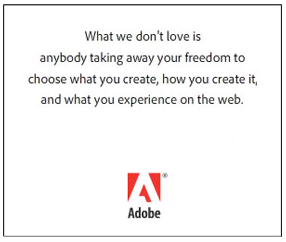
It's official. The public relations campaign Adobe has been waging against Apple (or is it Apple waging a war against Adobe?) is now an interactive advertising campaign. I'm not sure if this reeks of desperation or defiance, but I do know that Adobe will need to release some non-Flash based ads if it expects to get the attention of current iPhone and iPad users. The campaign is currently running rampant online as well as in print:

To coincide with the campaign, Adobe has a new section of their website dedicated to "Freedom of choice":

What do you think? Desperation or strategic offensive? I'm not sure who these ads are targeting, but so far they aren't tugging at my heart strings.

Nick Kinports (follow him on Twitter @ADMAVEN) has worked in the interactive technology world for over 9 years, and helps the Fortune 100 identify unmet consumer needs, create ideas to fill those needs, and bring them into market. He currently works at Maddock Douglas.

Wednesday, May 12, 2010

Did You Hear? Privacy is Dead.

An easy way to predict the future is by watching movies.

I know, I know... Most movies about the future have no foundation in reality. But every once in a while we get a glimpse into what our fourth dimensional minds will produce in the next five to ten years.

Recently, Facebook founder Mark Zuckerberg expressed his desire to reveal more "private" data to public and media consumption, potentially opening the doors for targeted and highly interactive advertising. Let's get real for a second; before Facebook can go public (and trust me, it's not a matter of if, but when - regardless of what you hear from the officers of the company) they need more profit on the books, and the current advertising model isn't sustainable. I've already postulated on what the future of Facebook looks like, and wild as my vision may be the principle still holds water.

When I do technographic and digital behavior analysis of target audience groups, it's apparent that privacy boundaries are a generational phenomenon. What is considered personal and confidential by Generation X is thought of as open and public by Generation Y or Millennials. But what level of digital privacy is uncomfortable even for the tech savvy social medialites of today?

The 1997 film GATTACA (if you haven't seen it I highly recommend you do) features a bleak, postmodern world in which everything from employment to human coupling is based on genetic superiority, and establishing the validity of your mate or job candidate is as simple and painless as swiping a credit card.

Over the counter genetic testing technology is advancing at a startling pace. GATTACA may have given us a peek into what the future of these products holds.

Mixing a social technology cocktail

If testing yourself for genetic disease isn't scary enough, how about posting your results to Facebook? Are we preparing to raise a generation that literally has no privacy concerns? How about genetically targeted advertisements (bioadvertising) served based on likelihood of acceptance? Neuromarketing has nothing on this stuff...

UPDATE: Facebook VP of Public Policy Elliot Schrage comments on recent privacy missteps

Nick Kinports (follow him on Twitter @ADMAVEN) has worked in the interactive technology world for over 9 years, and helps the Fortune 100 identify unmet consumer needs, create ideas to fill those needs, and bring them into market. He currently works at Maddock Douglas.